What is how to carry electric scooter upstairs? It refers to the physical technique and mechanical preparation required to transport a micromobility device up vertical inclines or staircases without causing injury to the rider or damage to the scooter’s frame. In 2026, as urban density increases and “last-mile” commuting becomes the standard, mastering this skill is essential for anyone living in walk-up apartments or using multi-modal transit systems.
Let’s be honest: your electric scooter is your best friend until you hit a flight of stairs. Suddenly, that sleek 40-pound machine feels like a lead weight designed specifically to bruise your shins. I’ve spent years testing these devices in the concrete jungle of New York and the steep hills of San Francisco, and I can tell you that the difference between a seamless transition and a trip to the chiropractor lies in your technique.
Carrying a scooter isn’t just about raw strength; it’s about understanding center of gravity, latch integrity, and ergonomic positioning. Whether you are rocking a lightweight carbon fiber model or a heavy-duty long-range beast, there is a “right” way to handle the climb. In this guide, we will break down the mechanics of the lift, analyze the best gear for portability, and ensure you never look like a struggling turtle on your way to your third-floor studio again.
Quick Comparison: Weight, Portability, and Ease of Carry
Before we dive into the “how-to,” let’s look at how current 2026 models stack up regarding their “carry-ability.” Weight isn’t the only factor; the folding footprint and the thickness of the stem play massive roles in how your hand feels after two flights of stairs.
| Scooter Model | Weight (lbs) | Folding Style | Handlebar Girth | Best For |
| Unagi Model One Voyager | 28.5 lbs | One-click | Slim/Ergonomic | Five-story walk-ups |
| Segway Ninebot Max G2 | 53.5 lbs | Safety Latch | Wide/Thick | Short flights only |
| Apollo City 2025 | 57 lbs | Triple-lock | Medium | Power + Portability |
| NIU KQi3 Max | 46.3 lbs | Quick-release | Thick | Daily subway use |
| Fluid FreeRide Horizon | 42 lbs | Classic Pin | Adjustable | Budget commuters |
Analysis of Portability Data
As the table illustrates, the Unagi Model One Voyager remains the undisputed king of the “staircase commute” due to its sub-30lb weight. However, users should note that the Segway Ninebot Max G2, while significantly heavier, offers a “sturdier” stem grip that some find easier to hold for very short distances despite the bulk. If you are facing more than three flights of stairs daily, any device over 50 lbs will eventually lead to fatigue unless you employ specific carrying accessories.
💬 Just one click — help others make better buying decisions too! 😊
Top 5 Electric Scooters for Stair Climbers: Expert Analysis
Choosing a scooter based on how it feels in your hand while walking is a pro-level move. Most people look at top speed; smart people look at the folding latch. Here are the top contenders in 2026.
1. Unagi Model One Voyager — The Weightless Wonder
The Unagi Model One Voyager utilizes a TORAY carbon fiber frame that keeps the weight around 28-29 lbs. This isn’t just a spec; it’s a lifestyle change.
Expert Commentary: What most buyers overlook is the “One-Click” folding mechanism. In my experience, it’s the most consistent latch on the market. While the 250W dual motors (500W total) provide decent pep for urban flats, the real value is the lack of “stem wobble” when you’re carrying it. The stem is teardrop-shaped, which fits more naturally into the palm of your hand than a standard circular pipe. It’s perfect for the “Suitcase Carry” method.
-
Key Specs: 25-mile range, 20 mph top speed, 28.5 lbs total weight.
-
Customer Feedback: Users consistently praise the aesthetics but note that the solid tires make for a bumpy ride if the stairs lead to a cobbled street.
-
Pros: Incredible weight-to-power ratio; sleek design; effortless folding.
-
Cons: No suspension; shorter range than heavier competitors.
-
Value Verdict: Expect to pay in the $850-$1,000 range. It is the best investment for high-floor apartment dwellers.
2. Segway Ninebot Max G2 — The Reliable Tank
The Segway Ninebot Max G2 is the 2026 iteration of the world’s most famous rental-grade scooter. It weighs in the mid-50s (around 53-55 lbs), which is the upper limit for “hand carrying.”
Expert Commentary: The spec sheet says 53 lbs, but because the weight is concentrated in the rear motor and the massive battery deck, it feels “tail-heavy.” When learning how to carry electric scooter upstairs with this model, you must grip the stem further back than you’d expect to balance the load. The inclusion of hydraulic front suspension and rear spring suspension makes it heavy, but the ride quality is so superior that many find the extra 20 lbs worth the workout.
-
Key Specs: 43-mile range, 22 mph top speed, 900W peak power.
-
Customer Feedback: Commuters love the “bulletproof” feel but warn that it requires two hands for long staircases.
-
Pros: Exceptional range; built-in Apple Find My; very comfortable ride.
-
Cons: Very bulky when folded; heavy for smaller riders.
-
Value Verdict: Usually priced around $800-$950. Best for those with only one flight of stairs and a long road ahead.

3. Apollo City 2025 — The Tech-Forward Choice
The Apollo City 2025 represents the mid-range sweet spot. It’s a 57-lb machine that handles like a sports car.
Expert Commentary: Apollo’s 2025 folding mechanism is a “triple-lock” system. While this adds 5 seconds to your “fold time,” it ensures the stem never unlatches while you are mid-flight on a staircase—a safety hazard I’ve seen on cheaper models. The integration of regenerative braking means you’re actually gaining a tiny bit of charge back before you even hit the stairs. I recommend this for the “Shoulder Carry” technique due to its balanced frame.
-
Key Specs: 32 mph top speed, 38-mile range, IP66 water resistance.
-
Customer Feedback: High marks for the App integration and “turn signals,” though some find the folding latch “fiddly” at first.
-
Pros: Great speed; excellent water protection; robust build.
-
Cons: Heaviest on this list; requires more maintenance.
-
Value Verdict: Found in the $1,200-$1,400 range. Best for “power commuters” who don’t mind a little extra weight.
4. NIU KQi3 Max — The Ergonomic King
NIU has focused heavily on rider geometry, and the NIU KQi3 Max shows it with a wider-than-average deck and a 75-degree stem angle.
Expert Commentary: This model weighs around 46 lbs. The “interpretation” of this weight is interesting: because the stem is thicker and the handlebars are wider (542mm), it provides a very stable lever when lifting. It doesn’t “swing” as much as the Unagi. The “KQi” series is known for its “Halo” headlight, which is actually useful if you’re carrying your scooter up a poorly lit apartment stairwell at night.
-
Key Specs: 23.6 mph top speed, 40-mile range, 10-inch self-healing tires.
-
Customer Feedback: Highly rated for its “easy-to-read” display and braking reliability.
-
Pros: Stable handling; great safety features; self-healing tires.
-
Cons: Charging takes a long time (8+ hours); folding clip is plastic.
-
Value Verdict: Mid-tier pricing around $750-$900. Great for university students.
5. Fluid FreeRide Horizon — The Compact Versatility Choice
The Fluid FreeRide Horizon is a cult favorite for one reason: the handlebars fold down too.
Expert Commentary: Most scooters stay “wide” even when the stem is down. The Horizon’s folding handlebars reduce the “width” profile significantly. This is a game-changer for narrow stairwells where you might clip the wall or a neighbor’s door. At 42 lbs, it sits in that “manageable” category for most adults. The rear drum brake and regenerative braking setup is low-maintenance, which is what you want if you’re banging it around on stairs.
-
Key Specs: 23-25 mph top speed, 25-30 mile range, 42 lbs.
-
Customer Feedback: Commuters appreciate the “portability” but note the solid rear tire can be slippery on wet stairs.
-
Pros: Narrowest folded profile; adjustable height stem; good price.
-
Cons: Dated aesthetics; solid rear tire lacks grip.
-
Value Verdict: Budget-friendly choice around $650-$750.
✨ Don’t Miss These Exclusive Deals!
🔍 Take your commute to the next level with these carefully selected products. Click on any highlighted item to check current pricing and availability. These tools will help you create authentic travel experiences your back will love!
Mastering the Lift: A Practical Usage Guide (Transformation)
Knowing how to carry electric scooter upstairs isn’t just about picking it up; it’s about a sequence of movements that protects your lumbar spine and the scooter’s sensitive electronics. According to the Consumer Product Safety Commission (CPSC), many micromobility injuries occur during non-riding activities, including lifting and charging.
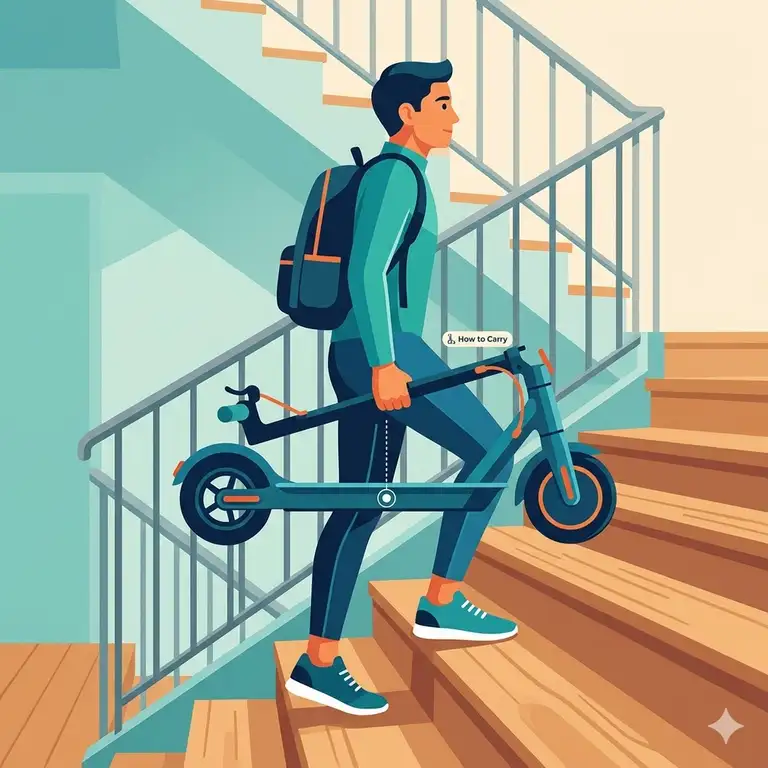
The “Suitcase Carry” Method (Best for <40 lbs)
This is the standard move for lightweight models like the Unagi.
-
Fold and Lock: Ensure the folding hook is fully engaged with the rear fender or dedicated latch. Give it a “test tug.”
-
The Approach: Stand on the left side of the scooter (opposite the kickstand).
-
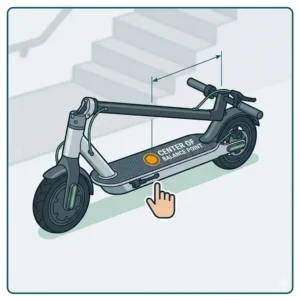
The Grip: Grab the stem at its balance point—usually about 1/3 of the way up from the folding hinge.
-
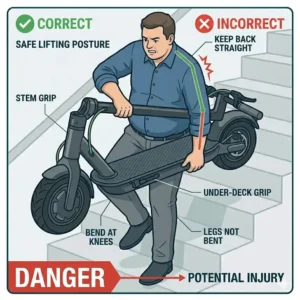
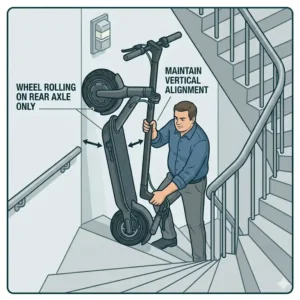
The Lift: Bend your knees, keep your back straight, and lift. Hold the scooter close to your body.
-
The Climb: Keep the “front” of the scooter (the handlebars) pointing up the stairs. This prevents the heavy motor wheel from pulling you backward.
The “Shoulder Sling” Method (Best for >40 lbs)
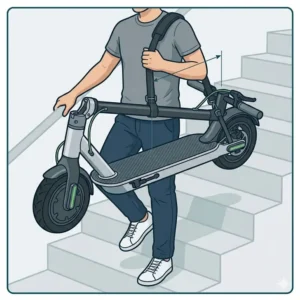
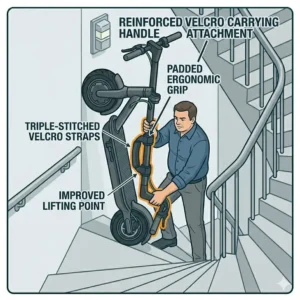
For heavier models like the Apollo City or Segway, using your shoulder muscles is more sustainable than relying on grip strength.
-
Preparation: Purchase a dedicated “Scooter Shoulder Strap.”
-
Attachment: Hook the strap to the base of the stem and the rear assembly.
-
The Toss: Loop the strap over your dominant shoulder.
-
Stabilization: Keep one hand on the stem to prevent the scooter from swinging into your legs.
-
Center of Gravity: Lean slightly forward as you climb to align the scooter’s weight over your hips.
Real-World Scenario: The “Subway-to-Walk-up” Case Study
Let’s look at two hypothetical users to see how product choice changes the experience of carrying a scooter upstairs.
Scenario A: “The High-Rise Professional”
-
Profile: Sarah, works in a 4th-floor office with no elevator access for bikes/scooters.
-
Need: Professional appearance, minimal sweat, rapid folding.
-
The Match: Unagi Model One Voyager.
-
Why: Sarah can fold the Unagi in 2 seconds at the building entrance. Because it weighs under 30 lbs, she can carry it like a briefcase without ruining her blazer or arriving out of breath. The lack of bulk means she can navigate the crowded stairwell during morning rush hour without hitting other commuters.
Scenario B: “The Long-Distance Commuter”
-
Profile: Mark, commutes 12 miles round-trip and has a 2-flight walk-up at home.
-
Need: Range and suspension for rough roads.
-
The Match: Segway Ninebot Max G2.
-
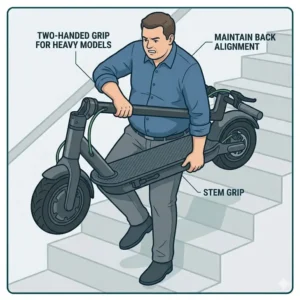
Why: Mark needs the range. He accepts the “weight penalty” of 53 lbs. To make his 2-flight climb easier, Mark installed a “Heavy Duty Carry Handle” accessory on the stem. By using a two-handed grip (one on the stem, one on the handle), he distributes the weight and protects his lower back. He treats the climb as a 30-second “mini-workout” at the end of his day.
How to Choose the Right Weight for Your Living Situation
When browsing for your next ride, use this “Staircase Math” to determine if a scooter is right for you.
-
Calculate Your “Max Lift”: Can you comfortably carry a 40lb suitcase up two flights? If no, stay under 30 lbs.
-
Measure Your Stairwell Width: Narrow NYC-style “spiral” or narrow stairs require scooters with folding handlebars like the Fluid FreeRide Horizon.
-
Check Latch Reviews: Go to YouTube or forums and look for “latch failure.” If a latch is known to pop open, do not buy it for stair use.
-
Evaluate Handlebar Girth: If you have smaller hands, a thick-stemmed scooter like the NIU will be harder to grip securely.
In my experience, the “perceived weight” is often more important than the actual weight. A 40lb scooter with a perfectly balanced handle feels lighter than a 35lb scooter where the weight is all in the front wheel. Always try to “test-lift” a model at a local showroom if possible.
Common Mistakes: How You’re Ruining Your Stem (and Your Back)
Carrying a scooter incorrectly is the fastest way to turn a $1,000 investment into a pile of scrap metal.
-
Lifting by the Handlebars: Never lift the scooter by the actual rubber grips or the brake levers. These components are not designed to support the full weight of the device. You will eventually strip the screws or snap a cable. Always lift by the metal stem.
-
The “Extended Arm” Carry: Holding the scooter far away from your body puts immense strain on your deltoids and lower back. This is how “slipped discs” happen. Keep the deck of the scooter resting slightly against your outer thigh (use a “deck cover” or “scooter bag” to keep your pants clean).
-
Ignoring the Latch “Click”: Many people fold their scooter and immediately lift. If you don’t hear that audible click of the safety latch, the scooter can unfold mid-air, potentially swinging down and breaking your ankle or damaging the stairs.
-
Ignoring Weight Distribution: If your scooter has a front-hub motor, the front is the heavy end. If it’s a rear-hub, the back is heavy. Always point the heavy end upstairs. If you lose your grip, the heavy end will fall onto the step rather than pulling you backward down the entire flight.
What to Expect: Real-World Performance vs. Spec Sheets
Manufacturers love to talk about “portable designs,” but they rarely mention the physical toll of a daily 3-story climb. In the real world, a “50-mile range” often implies a battery so large that the scooter becomes a permanent fixture of your ground floor because you’ll hate carrying it.
Expect a “break-in period” for your own muscles. If you’re new to the world of electric scooters, the first week of carrying it upstairs will be the hardest. By week three, your grip strength will have improved, and you’ll have developed “muscle memory” for the exact angle needed to clear the corners of your stairwell.
Also, be prepared for “Stairwell Scuffing.” The metal deck of a scooter can easily scratch paint or wood. If you rent your apartment, I highly recommend getting a “protective nose guard” for your scooter deck. This small rubber accessory prevents the metal from leaving marks on the stairs, potentially saving your security deposit.
Safety and Regulations: Stairs in Public Spaces
As of 2026, many transit authorities (like the MTA in New York or the CTA in Chicago) have specific rules about carrying scooters.
-
The “Folded Only” Rule: Most trains and buses require scooters to be folded before you even step onto the platform stairs.
-
Escalator Ban: Many cities have officially banned electric scooters from escalators due to several high-profile “jamming” incidents where a scooter wheel got caught in the teeth of the moving stairs. Always use the elevator or the traditional stairs.
-
The “Pedestrian First” Rule: When carrying your scooter upstairs in a public subway station, you are legally a pedestrian carrying luggage. You do not have “right of way.” Always stay to the right and allow unencumbered walkers to pass.
According to Wikipedia’s entry on Electric Scooter Regulations, local ordinances can change rapidly. Always check your city’s 2026 guidelines regarding micromobility in “vertical transit zones.”
Long-Term Ergonomics: Avoiding Chronic Injury
If you carry a 40lb weight daily with one hand, you are at risk for “Lateral Epicondylitis” (Tennis Elbow) or “Scooter Shoulder.” To avoid this, you must prioritize ergonomics.
-
Switch Sides: Don’t always carry the scooter with your right hand. Alternate days to ensure your muscular development is symmetrical.
-
Engage Your Core: Before you lift, “brace” your stomach muscles as if someone is about to poke you. This creates intra-abdominal pressure that protects your spine.
-
Use Proper Footwear: Carrying a heavy metal object while wearing flip-flops or high heels on stairs is a recipe for disaster. Wear shoes with a rubber sole and good “toe protection.”
-
The “Rest Stop” Strategy: If you live on the 5th floor, don’t try to “power through” all five flights in one go. Stop at the 3rd-floor landing, set the scooter down (gently!), and shake out your hands.
Total cost of ownership isn’t just about the electricity bill; it’s about your health. Investing in a slightly more expensive, lighter scooter like the Unagi often pays for itself in avoided medical bills or physical therapy sessions later.
✨ Don’t Miss These Exclusive Deals!
🔍 Take your [topic] to the next level with these carefully selected products. Click on any highlighted item to check current pricing and availability. These tools will help you create authentic [results] your family will love!
Conclusion
Mastering how to carry electric scooter upstairs is the final hurdle in becoming a truly “unbound” urban commuter. While the industry is trending toward more powerful (and thus heavier) machines, the savvy 2026 rider knows that portability is a feature, not a compromise. By choosing the right model—like the ultra-light Unagi Model One Voyager or the balanced NIU KQi3 Max—and employing proper ergonomic techniques, you can turn a grueling climb into a seamless part of your journey.
Remember: lift with your legs, lock your latch, and never be afraid to take a breather on the landing. Your back will thank you, and your scooter will stay in peak condition for years to come.
FAQs
❓ How to carry electric scooter upstairs without hurting my back?
✅ Always bend your knees and keep the scooter close to your center of gravity. Use a “Suitcase Carry” for light models and consider a shoulder strap for anything over 40 lbs. Never twist your torso while lifting the device…
❓ Can I leave my electric scooter in the hallway instead?
✅ Most 2026 fire codes and apartment leases strictly prohibit this. Scooters contain lithium-ion batteries and can block exit paths during emergencies. It is always safer (and often legally required) to carry it into your unit…
❓ Is it okay to “bounce” the scooter up the stairs on its tires?
✅ No. This puts immense stress on the motor axle and can lead to “internal rattling” or battery connection failures. The vibrations from “stair-thumping” are much more violent than standard road vibrations…
❓ What is the best accessory for carrying a heavy scooter?
✅ A “detachable shoulder strap” or a “middle-stem handle grip” are the most effective. These allow you to use larger muscle groups (shoulders and legs) rather than just your fingers and forearms…
❓ Can I carry my scooter while it is turned on?
✅ It is safer to turn the power off. An accidental bump of the thumb throttle while you are on the stairs could cause the drive wheel to spin, leading to a loss of balance or injury…
Recommended for You
- How to Balance on Electric Scooter First Time: 7 Easy Pro Steps
- Fat Tire Scooters for Sale: Top 7 Expert-Rated Models for 2026!
- Regular Scooters: 7 Expert Picks for Amazing Commutes
Disclaimer: This article contains affiliate links. As an Amazon Associate, I earn from qualifying purchases. If you purchase products through these links, we may earn a small commission at no additional cost to you.
✨ Found this helpful? Share it with your friends! 💬🤗