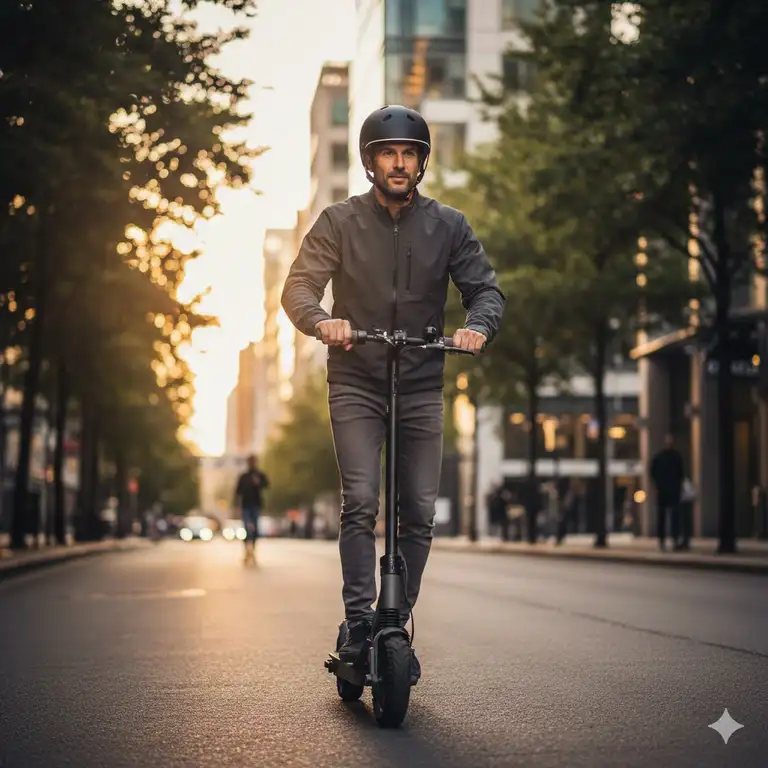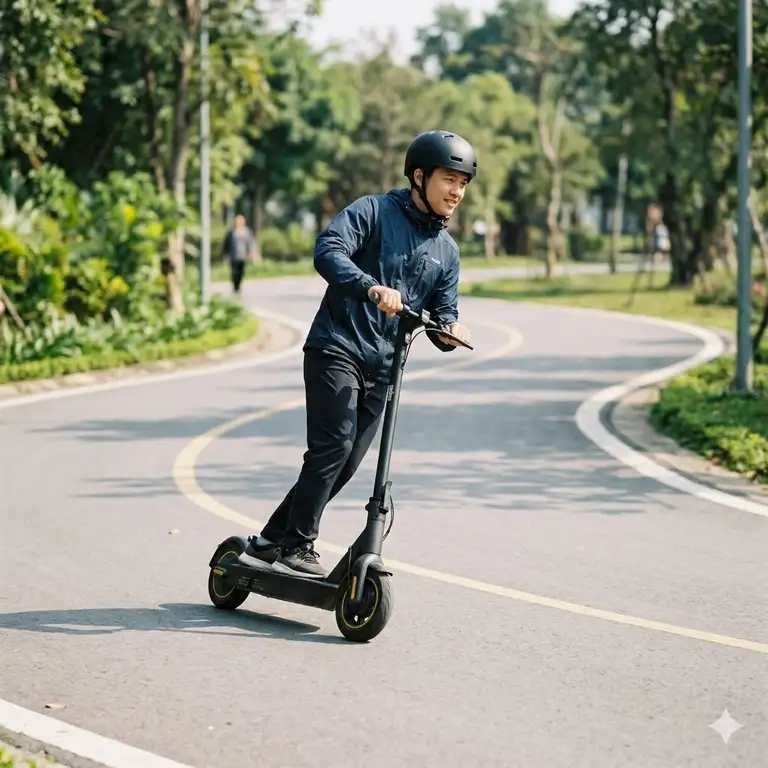
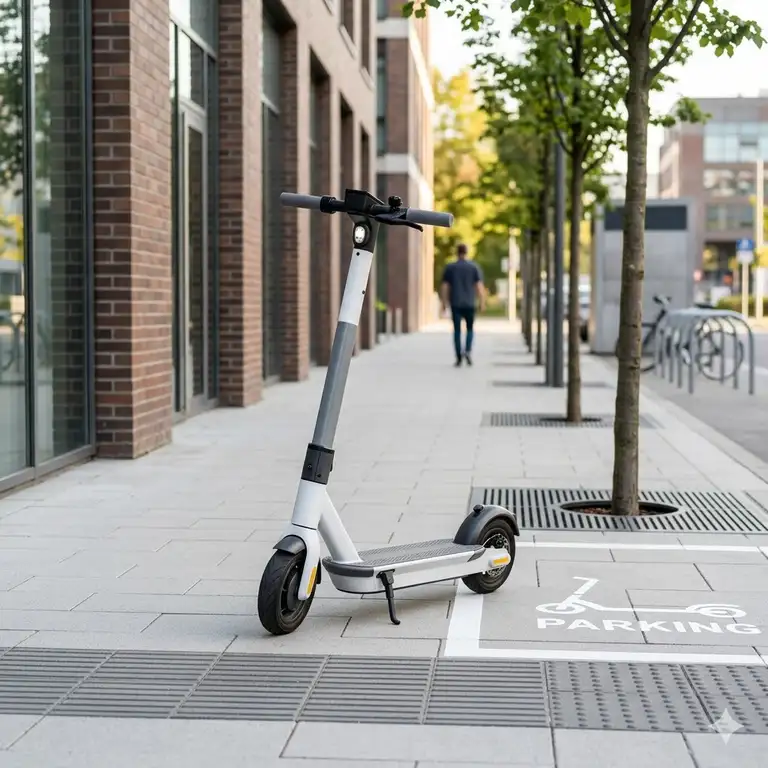
If you’ve ever walked down a busy city sidewalk in 2026, you’ve likely seen the carnage: electric scooters tossed haphazardly like discarded toys, blocking doorways and creating obstacle courses for pedestrians. Knowing how to park electric scooter properly isn’t just about being a “good neighbor”—it’s about protecting your investment from theft and avoiding the increasingly steep municipal fines that modern “smart cities” are handing out.
When we talk about how to park electric scooter properly, we are referring to the intentional act of securing an electric micromobility device in a designated or safe area that complies with local ADA (Americans with Disabilities Act) regulations, ensures the device does not obstruct public right-of-way, and utilizes appropriate locking mechanisms to deter theft. In 2026, with the integration of AI-monitored parking zones in cities like New York and San Francisco, getting this right is more critical than ever.
I’ve spent the last three years commuting via various e-scooters, and I’ve learned the hard way that a “quick five-minute park” can result in a tipped-over deck or, worse, a vanished vehicle. This guide will walk you through the nuances of urban parking etiquette, the gear you actually need, and the legal pitfalls you must avoid to keep your ride—and your reputation—intact.
Quick Comparison: Best Solutions for Secure Parking
| Feature | Physical Lock (U-Lock) | Integrated App Lock | Fold-and-Carry | Dedicated Docking |
| Security Level | High (Physical deterrent) | Low (Software only) | Maximum (Indoor storage) | Medium-High |
| Best For | High-traffic urban areas | Quick errands | Office/Home storage | Public transit hubs |
| Ease of Use | Moderate (Heavy) | High (One-tap) | Low (Heavy lifting) | High (Plug-in) |
| Cost Range | $40–$120 | Included | Free | Varies by city |
Looking at the comparison above, it’s clear that a physical U-lock remains the gold standard for anyone parking in public for more than a few minutes. While app-based locks are convenient for a coffee run, they do nothing to stop a thief from simply tossing your scooter into the back of a truck. For those who can manage the weight, the fold-and-carry method is the only 100% theft-proof solution, provided your destination allows indoor parking.
💬 Just one click — help others make better buying decisions too! 😊
Top 5 Essential Products for Secure Parking: Expert Analysis
Navigating the world of scooter accessories can feel like a maze of marketing hype. Below is a breakdown of the top tools and scooters that make the parking process seamless and secure in 2026.
1. Segway Ninebot Max G2 — The Stability King
The Segway Ninebot Max G2 features a built-in “Find My” integration and a kickstand that actually supports its weight.
-
Key Specs: 10-inch pneumatic tires and hydraulic front suspension. This means the scooter sits higher off the ground, requiring a sturdier kickstand than budget models—a feature Segway has reinforced to prevent the “tip-over” effect on uneven pavement.
-
Expert Opinion: In my experience, this is the best mid-range scooter for those who have to park on varied surfaces like cobblestone or cracked asphalt. The sheer weight (about 53 lbs) acts as a natural deterrent, but you should always pair it with a physical lock.
-
Customer Feedback: Users frequently praise the “Apple Find My” integration, noting it provides peace of mind when the scooter is out of sight.
-
Pros: Excellent stability, integrated tracking, high-visibility lighting.
-
Cons: Heavy to carry indoors, large footprint.
-
Price Range: Around $850-$950.
-
Value Verdict: Best for daily commuters who park in public areas and need built-in security features.
2. Kryptonite New York Fahgettaboudit U-Lock — Maximum Security
The Kryptonite New York Fahgettaboudit is the heavy hitter of the lock world, designed for high-theft urban environments.
-
Key Specs: 18mm hardened steel shackle. This diameter is effectively immune to most hand-held bolt cutters, forcing a thief to use a loud, sparking angle grinder—which is a major psychological deterrent.
-
Expert Opinion: What most buyers overlook is the shackle length; it’s short. While this increases security (less room for a pry bar), it means you have to park very close to the rack. It’s the “tough love” of locks.
-
Customer Feedback: “Indestructible” is the common refrain, though many note the weight is a significant trade-off for the security level.
-
Pros: Top-tier security rating, protective vinyl coating, lifetime key replacement.
-
Cons: Very heavy (nearly 5 lbs), limited reach.
-
Price Range: Around $110-$130.
-
Value Verdict: The ultimate insurance policy for parking expensive scooters in high-crime areas.
3. NIU KQi3 Max — The Intelligent Parker
The NIU KQi3 Max offers a wider deck and an industry-leading headlight for safer night-time parking visibility.
-
Key Specs: 450W motor with a wide 25% climbing grade. The wide deck isn’t just for comfort; it provides a more stable center of gravity when leaned against a bike rack, making it less likely to slide and scratch the frame.
-
Expert Opinion: NIU’s app-based locking system is surprisingly robust, disabling the motor and triggering an alarm if the scooter is moved. It’s perfect for those “quick-stop” scenarios where you’re still within earshot.
-
Customer Feedback: Owners love the “halo” light which makes the scooter easy to find in a crowded bike rack at dusk.
-
Pros: Wide stable deck, great app integration, powerful motor.
-
Cons: Thumb throttle can be fatiguing, slightly bulky.
-
Price Range: Around $750-$890.
-
Value Verdict: The best balance of tech-security and physical stability for suburban and city use.
4. Master Lock Street Cuff — The Convenience Factor
The Master Lock Street Cuff uses a handcuff-style design that is particularly suited for the narrow stems of electric scooters.
-
Key Specs: 3-inch cuffs with a 9-link chain. The cuff design allows you to lock around the stem or the folding mechanism, which are often too thick for traditional small U-locks but too thin for large ones.
-
Expert Opinion: Don’t let the “cool” factor fool you; these are for medium-security areas. They are incredibly easy to clip on and off, making them my go-to for coffee shop runs where I can see the scooter through the window.
-
Customer Feedback: Users appreciate how flat they fold, fitting easily into a backpack or a small deck bag.
-
Pros: Unique fit for scooter stems, highly portable, quick to engage.
-
Cons: Shorter reach than cables, lower security than U-locks.
-
Price Range: Around $50-$65.
-
Value Verdict: Best for “stop-and-go” riders who value portability over maximum brute-force resistance.
5. Hiboy S2 — The Budget-Friendly Portable
The Hiboy S2 is a classic choice for those who prefer to avoid public parking altogether by bringing the ride inside.
-
Key Specs: Solid tires and a 350W motor. Solid tires mean you never have to worry about a flat while the scooter is parked—a common “vandalism” issue in some cities.
-
Expert Opinion: This scooter is designed for the “Last Mile.” Its folding mechanism is one of the quickest in the industry, making it the ideal candidate for someone who parks under their desk at work.
-
Customer Feedback: Most users highlight the value-for-money, though some mention the ride is stiffer due to the solid tires.
-
Pros: No-flat tires, very lightweight, affordable.
-
Cons: Limited range, bumpy ride on rough pavement.
-
Price Range: Around $300-$400.
-
Value Verdict: The best entry-level scooter for students or office workers with indoor parking access.
Top 5 Products Comparison: Specification & Analysis
| Product | Security Type | Weight | Best Use Case | Price Range |
| Segway Max G2 | Integrated + App | 53 lbs | Heavy Commuting | $850-$950 |
| Kryptonite NY | U-Lock (Heavy) | 4.5 lbs | High-Risk Urban | $110-$130 |
| NIU KQi3 Max | App + Physical | 46 lbs | Technology Fans | $750-$890 |
| Master Lock Cuff | Link Lock | 3 lbs | Quick Stops | $50-$65 |
| Hiboy S2 | Folding/Portable | 28 lbs | Indoor/Budget | $300-$400 |
Looking at this data, the Segway Ninebot Max G2 offers the most comprehensive features for modern parking, but its weight requires a dedicated ground-floor storage spot or a very sturdy lock. For those on a budget, the Hiboy S2‘s portability solves the “parking problem” by removing the need to park outside entirely. If you own any scooter over $700, the Kryptonite New York Fahgettaboudit is not an option—it’s a requirement for urban survival.
✨ Don’t Miss These Exclusive Deals!
🔍 Take your scooter security to the next level with these carefully selected products. Click on any highlighted item to check current pricing and availability. These tools will help you create a safe, stress-free commute that your wallet will love!
Practical Usage Guide: Your First 30 Days of Scooter Ownership
Getting used to a new e-scooter involves more than just learning how to throttle and brake. The first month is when most “parking accidents” happen. Here is how to navigate those early days and optimize your routine for longevity.
Phase 1: The “Home Base” Setup
Before you even take your first ride, designate a parking spot at home. Ideally, this should be a cool, dry place. Avoid parking your scooter near heat sources or in direct sunlight, as the lithium-ion batteries are sensitive to temperature extremes. If you park in a garage, ensure the charger is on a flat, non-flammable surface.
Phase 2: The First Public Park
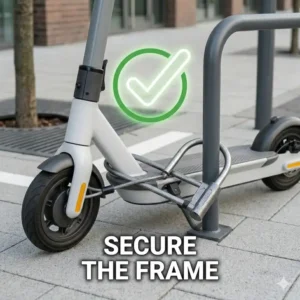
On your first trip to the store, give yourself an extra five minutes to find a “goldilocks” parking spot. What is a goldilocks spot? It’s not too hidden (where thieves can work in private) and not too crowded (where other bike owners might knock your scooter over). Look for municipal bike racks that are bolted into the concrete. Avoid “sucker poles”—signs that can be easily pulled out of the ground or that have a short top where a lock can be lifted over.
Phase 3: The Maintenance Check
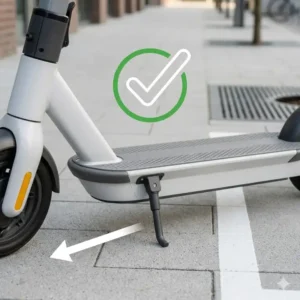
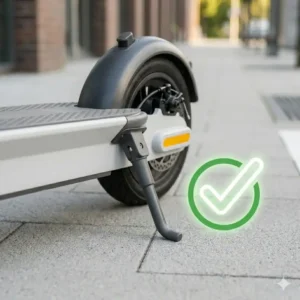
By day 30, your kickstand might start to feel loose. This is a common issue due to the vibrations of city riding. Carry a small multi-tool and tighten the kickstand bolts once a month. A floppy kickstand is the leading cause of “ghost tipping,” where a scooter falls over hours after you walked away.
Real-World Scenarios: Parking at Work vs. The Grocery Store
Understanding how to park electric scooter properly changes based on your destination. The “vibe” and security level of an office building are vastly different from a chaotic supermarket parking lot.
Scenario A: The Professional Office
If you work in a corporate environment, your first move should be to check with building security. Many modern offices in 2026 have dedicated micromobility rooms with charging stations.
-
The Strategy: Fold your scooter before entering the lobby. It signals that you are “carrying luggage” rather than “riding a vehicle,” which makes security much friendlier. If you must park in a parking garage, use the most heavy-duty U-lock you own and try to lock it near the attendant’s booth.
Scenario B: The Quick Grocery Run
Grocery stores are high-traffic areas where people are often distracted by carts and bags.
-
The Strategy: Avoid parking right next to the entrance where foot traffic is highest. Find a bike rack at the edge of the store’s “apron.” Use a lock that is quick to deploy, like the Master Lock Street Cuff. Because you’ll only be inside for 15-20 minutes, speed is your friend, but never leave it unlocked, even for a “one-item” trip.
Scenario C: The Multi-Modal Transit Hub
Parking at a train station or bus terminal is the “boss level” of scooter parking. These are high-theft zones.
-
The Strategy: Use two locks. It sounds like overkill, but thieves look for the path of least resistance. A U-lock on the frame and a cable lock through the wheels will make a thief move on to an easier target. Also, remove any detachable lights or bags. If it’s not bolted down, it will be gone by the time you commute back.
The Golden Rules of Sidewalk Etiquette
In 2026, many US cities have implemented “clear path” laws. If your parked scooter blocks a sidewalk to the point where a wheelchair cannot pass, you can face fines ranging from $50 to $250.
-
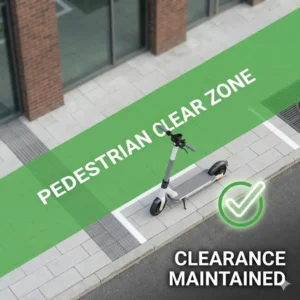
The 36-Inch Rule: Always ensure there is at least 36 inches of clear space on the sidewalk. This is the standard width required for ADA compliance.
-
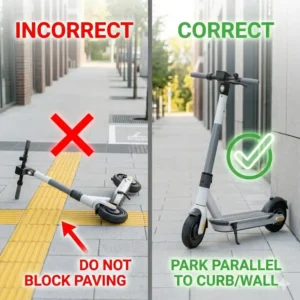
Avoid the “Furniture Zone”: Park your scooter in the area of the sidewalk that already has trees, benches, or light poles. This keeps the “pedestrian zone” clear for walking.
-
Parallel, Not Perpendicular: If there is no bike rack, park your scooter parallel to the curb or a building wall. A scooter sticking out like a sore thumb is a trip hazard and a magnet for “accidental” kicks from annoyed pedestrians.
-
No Blocking Ramps: This should go without saying, but never park near the “curb cuts” at intersections. These are vital for people with mobility issues.
Anti-Theft Strategies: More Than Just a Lock
While physical locks are essential, how to park electric scooter properly also involves psychological warfare and tech-savviness.
The Power of “Ugly”
Thieves want high-resale items. A pristine, shiny scooter is a target. Some seasoned commuters use “stealth” tactics—adding stickers or even bits of duct tape to make the scooter look older or more worn than it is. It sounds crazy, but it works.
GPS and Alarms
In 2026, most high-end scooters come with GPS, but for budget models, you can hide an AirTag or a Tile inside the deck or the stem. Furthermore, motion-sensor alarms (which can be bought for around $15-$25) are incredibly effective. A 110dB siren going off in a quiet neighborhood will stop a thief in their tracks.
Strategic Location
Always park in well-lit areas with high foot traffic. Thieves hate an audience. If you can park within the field of view of a security camera (many storefronts have them clearly visible), do so. Even a “dummy” camera can be a deterrent.
How to Choose the Right Parking Spot (Expert Criteria)
When I’m looking for a place to leave my ride, I run through a mental checklist. If a spot fails more than two of these, I move on.
-
Anchor Permanence: Is the object I’m locking to bolted into the ground? Give it a good shake. If it moves, it’s not a parking spot; it’s a suggestion.
-
Visibility: Can I see this spot from the window of my destination? If not, is it in a place where dozens of people pass by every minute?
-
Weather Protection: Is there an awning or overhang? Direct rain can seep into even “water-resistant” (IPX5/IPX6) scooters over several hours, leading to corrosion of the folding mechanism.
-
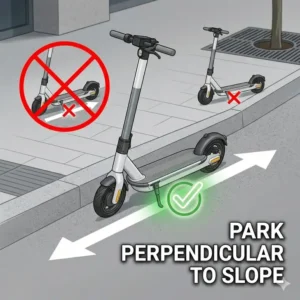
Surface Levelness: Is the ground flat? A slight incline can cause the scooter to roll off its kickstand. Always face the scooter uphill if you must park on a slope.
-
Proximity to Heavy Vehicles: Avoid parking at the very edge of the street where delivery trucks or snowplows might clip your handlebars.
Common Mistakes: Why Your Scooter Got Impounded
Many riders find out how to park electric scooter properly only after their scooter is towed by the city. Here are the most common “fail” scenarios:
-
Locking to Private Property: Just because there’s a sturdy fence doesn’t mean you can lock to it. Business owners are notorious for clipping locks on scooters that block their decorative wrought iron.
-
The “Double-Park”: Never lock your scooter to someone else’s bike or scooter. It’s the ultimate etiquette breach and a sure-fire way to get your tires kicked.
-
Forgetting the Key: It sounds simple, but many people engage a disc lock or U-lock and then realize they left the key at home. In 2026, I highly recommend using a combination U-lock or a smart lock that uses your phone’s biometrics.
-
Leaving the Battery Exposed: If your scooter has a removable battery, take it with you. Not only does this prevent the theft of a $300 component, but it also makes the scooter much less valuable to a potential thief.
Weather Considerations: Parking in Heat and Rain
Nature is the silent enemy of the electric scooter. Parking properly means accounting for the elements.
Heat and Batteries
In the peak of summer, pavement temperatures can exceed 140°F. If you park your scooter in direct sun, the black metal casing of the deck acts like an oven for the battery cells. This can lead to “thermal runaway” or, more commonly, a significantly shortened battery lifespan. Always seek shade.
Rain and Corrosion
Even if your scooter has a high IP rating, parking in the rain is a gamble. Water can pool in the charging port or the display housing. If you must park in the rain, use a small “scooter raincoat”—a specialized silicone cover for the dashboard. After your ride, ensure you dry the charging port with a microfiber cloth before plugging it in.
Scooter vs. Bike: Shared Parking Space Dynamics
The relationship between cyclists and scooter riders is… complicated. To park electric scooter properly, you need to respect the “OGs” of the bike rack.
-
Don’t Hog the Rack: A scooter is generally thinner than a bike. Use that to your advantage. Try to tuck into the “dead space” at the end of a rack rather than taking up a spot in the middle that could fit a full-sized mountain bike.
-
Handlebar Interference: Scooter handlebars are often at the same height as bike seats. When you park, ensure your brake levers aren’t poking into someone’s spokes or snagging their gear cables.
-
The Lean: If the rack is full, you might be tempted to lean your scooter against a bike. Don’t. This is the fastest way to start an argument. If there’s no room, find another rack.
The Legal Landscape of Micromobility Parking in 2026
Laws are changing rapidly. In 2026, many cities have moved toward “Mandatory Parking Zones” (MPZs).
-
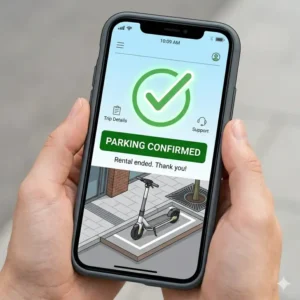
Geo-Fencing: Many rental scooters (like Lime or Bird) use GPS to ensure you can only end your ride in a specific zone. Private owners should pay attention to these zones too, as they usually indicate where the city wants micromobility to stay.
-
ADA Lawsuits: There has been a surge in lawsuits against cities regarding sidewalk obstructions. Consequently, cities are being much more aggressive about impounding any vehicle—private or rental—that violates clear-path rules.
-
Insurance Requirements: Some states now require a “parking permit” or registration for e-scooters that exceed 20 mph. Ensure your registration sticker is visible when parked, as “unidentified” vehicles are often the first to be hauled away during street cleanings.
Long-Term Maintenance: How Parking Impacts Battery Life
Parking isn’t just a stationary state; it’s a maintenance state. How you leave your scooter for 8 hours a day during work determines how many years it will last.
-
The 80% Rule: If you park your scooter and plan to charge it, try to stop at 80% if you aren’t riding again immediately. Leaving a battery at 100% in a hot storage area creates internal stress on the cells.
-
Tire Flat-Spots: If you park your scooter for weeks at a time (e.g., during winter), try to keep the tires off the cold ground. Over time, the weight of the scooter can create a “flat spot” in the rubber, leading to a bumpy ride later.
-
Folding Mechanism Lubrication: When you park and fold your scooter daily, you are putting wear on the locking hinge. Apply a drop of lithium grease to the folding pin every 100 miles to keep the action smooth.
✨ Don’t Miss These Exclusive Deals!
🔍 Take your scooter security to the next level with these carefully selected products. Click on any highlighted item to check current pricing and availability. These tools will help you create a safe, stress-free commute that your wallet will love!
Conclusion
Mastering how to park electric scooter properly is the final step in becoming a true urban commuter. It’s a blend of choosing the right gear—like the Segway Ninebot Max G2 for stability or the Kryptonite New York Fahgettaboudit for security—and exercising common-sense etiquette. By respecting the sidewalk and the people who use it, you protect the future of micromobility for everyone.
Remember, a well-parked scooter is a safe scooter. Take the extra thirty seconds to find a sturdy anchor, check your clear-path distance, and engage your locks. Your ride (and your peace of mind) is worth the effort.
FAQs
❓ Can I park my electric scooter on the sidewalk?
✅ Yes, in most U.S. cities, you can park on the sidewalk provided you leave at least 36 to 48 inches of space for pedestrians and ADA compliance. Always park near the curb or in the “furniture zone” away from building entrances…
❓ What is the best lock for an electric scooter in 2026?
✅ A hardened steel U-lock, like the Kryptonite New York Fahgettaboudit, is considered the best for high-security. For portability, the Master Lock Street Cuff is highly effective for the unique geometry of scooter stems…
❓ Will rain ruin my scooter if I park it outside?
✅ While most modern scooters are water-resistant (IPX4 or higher), prolonged exposure to rain can cause corrosion in the folding joints and electrical shorts in the dashboard. It is always best to use a waterproof cover or find an overhang…
❓ Can the city impound my private electric scooter?
✅ Yes, if your scooter is blocking a public right-of-way, fire hydrant, or handicap ramp, city officials have the authority to impound it. Reclaiming a private scooter often involves a fine and proof of ownership…
❓ How do I prevent my scooter from being knocked over?
✅ Always park on level ground and face the scooter uphill if on a slope. Ensure your kickstand is tightened and use the “wide-stance” method if your scooter deck allows it, providing a more stable center of gravity…
Recommended for You
- How to Ride Scooter at Night Safely: 7 Expert Safety Tips for 2026
- 5 Expert Tips: How to Use Electric Scooter in Rain Safely (2026)
- How to Turn Properly on Electric Scooter: 7 Game-Changing Tips for Effortless Turning
Disclaimer: This article contains affiliate links. As an Amazon Associate, I earn from qualifying purchases. If you purchase products through these links, we may earn a small commission at no additional cost to you.
✨ Found this helpful? Share it with your friends! 💬🤗