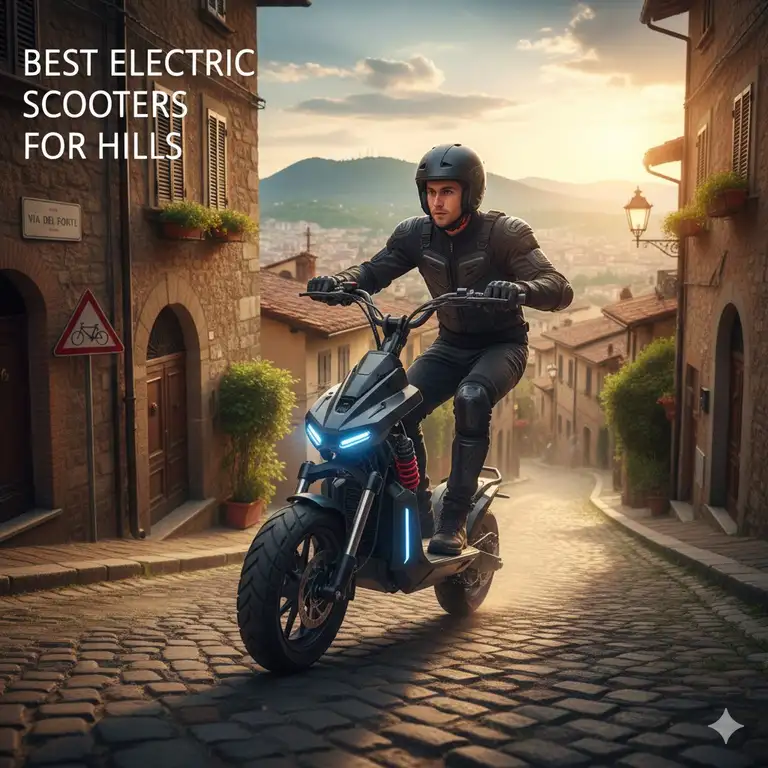
I’ve been there. You’re cruising along on a beautiful morning, the wind is in your hair, and then you see it: the “hill of doom” that stands between you and your office. If you’ve ever tried to tackle a 15% grade on a cheap budget ride, you know the feeling of the motor groaning as you slowly come to a pathetic, crawling halt. It’s embarrassing and, frankly, a waste of your time. This is why finding the best electric scooters for hills isn’t just a luxury; it’s a necessity for anyone living in cities like San Francisco, Seattle, or even hilly parts of Austin.
✨Was this helpful? Spread the word! 🚀
When I first started testing these machines, I thought a “motor is a motor.” Boy, was I wrong. The difference between a commuter built for flat pavement and a hill climbing electric scooter is like the difference between a golf cart and a Jeep. You need torque, you need voltage, and you need a battery that won’t give up the ghost the moment things get vertical. In this guide, I’m going to break down the heavy hitters of 2026 that actually deliver on their promises.
Comparing Hill-Climbing Solutions
Before we dive into the nitty-gritty of the best electric scooters for hills, let’s look at how an e scooter for hills stacks up against other ways to get up those inclines.
| Feature | Electric Scooter for Hills | Electric Bike | Walking | Standard Kick Scooter |
| Effort Level | Zero (Pure Throttle) | Low to Medium (Pedal Assist) | High | Extremely High |
| Portability | High (Foldable) | Low (Heavy/Bulky) | N/A | High |
| Steep Grade Speed | 15-25 mph | 10-20 mph | 2-3 mph | < 1 mph |
| Sweat Factor | 0% | 10-20% | 100% | 150% |
| Storage | Under a desk | Needs a rack/garage | N/A | Anywhere |
Quick Comparison: Top 7 Best Electric Scooters for Hills
If you’re in a hurry to start your hill climbing journey, here is a snapshot of the top contenders we’ve vetted for 2026.
| Product Model | Best For | Max Incline | Motor Power |
| Segway Ninebot MAX G2 | Daily Commuting | 22% | 1000W Peak |
| NIU KQi3 Max | Value & Reliability | 25% | 900W Peak |
| Apollo City 2024 | Tech Lovers | 20% | Dual 500W |
| Gotrax GX1 | Entry-Level Performance | 25% | Dual 600W |
| Hiboy S2 Pro | Budget-Friendly | 15% | 500W Rated |
| Dualtron Victor Luxury | Extreme Power | 35% | 4000W Peak |
| Kaabo Wolf Warrior X GT | Off-Road & Steep Hills | 35% | Dual 1100W |
Top 7 Best Electric Scooters for Hills: Expert Analysis
1. Segway Ninebot Kickscooter MAX G2
The Segway Ninebot Kickscooter MAX G2 is the successor to the legendary G30P, and it has specifically improved its ability as an electric scooter for steep hills. While the original was a tank, the MAX G2 adds a much-needed suspension system and a more powerful rear-wheel drive motor. Consequently, it handles urban slopes with much more grace than its predecessor.
-
Technical Specifications:
-
Motor: 1000W Peak Power (Rear Drive)
-
Max Speed: 22 mph
-
Range: Up to 43 miles (Eco mode)
-
Incline: 22% Grade
-
Tires: 10-inch self-healing tubeless
-
Braking: Front drum + Electronic rear
-
-
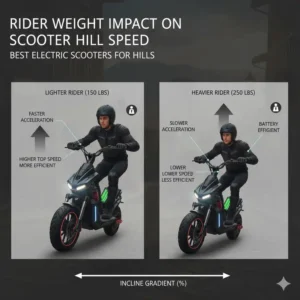
Customer Review Analysis: Users frequently praise the build quality and the “set it and forget it” reliability. Some heavier riders (over 220 lbs) note that while it handles 15% hills well, it does slow down on anything steeper.
-
Pros: Incredible ride comfort thanks to hydraulic front and spring rear suspension; Apple Find My integration.
-
Cons: It’s quite heavy at 53 lbs; charging takes about 6 hours.
-
Warranty: 1-year limited warranty on major components.
-
Professional Applications: Ideal for “last mile” commuters who need to store the scooter in an office but have a hilly route home.
2. NIU KQi3 Max
When looking for the best electric scooter for hills in the mid-range category, the NIU KQi3 Max consistently hits the mark. NIU uses a 48V system that provides significantly more “oomph” than standard 36V scooters. Therefore, when you hit a slope, the torque stays consistent rather than dropping off immediately.
-
Technical Specifications:
-
Motor: 450W Rated / 900W Peak
-
Max Speed: 23.6 mph
-
Range: 40.4 miles
-
Incline: 25% Grade
-
Voltage: 48V Lithium Battery
-
Safety: Iconic Halo headlight + mechanical disc brakes
-
-
Customer Review Analysis: Reviewers love the wide deck and handlebars, stating it feels more stable than a Segway. The climbing ability is highly rated for a single-motor unit.
-
Pros: Very wide tires (9.5 x 2.5inches) for stability; excellent app connectivity.
-
Cons: No built-in suspension, so you’ll feel the bumps on rough roads.
-
Warranty: 2-year warranty (rare in this industry).
-
Professional Applications: Perfect for university students or urban delivery workers who need a durable, high-visibility ride.
3. Apollo City 2024
The Apollo City 2024 is often cited as the best electric scooter for climbing hills if you want a dual-motor setup that doesn’t look like a sci-fi prop. Apollo has focused on “integration,” meaning the wires are hidden, and the lights are built into the frame. It uses two smaller motors to provide all-wheel drive, which is a game-changer for traction on wet hills.
-
Technical Specifications:
-
Motor: Dual 500W (1000W Total Rated)
-
Max Speed: 32 mph
Range: 43 miles
-
Incline: 20% Grade
-
Regen Braking: Dedicated “Power RBS” thumb throttle
-
Water Resistance: IP66 (best in class)
-
-
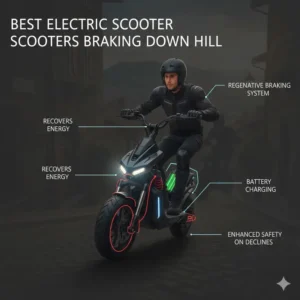
Customer Review Analysis: Tech enthusiasts adore the regenerative braking, which actually puts energy back into the battery while going down the hills you just climbed. Some users found the initial assembly a bit tricky.
-
Pros: Best-in-class water resistance; smooth acceleration; minimal maintenance.
-
Cons: Higher price point; stem folding mechanism has a learning curve.
-
Warranty: 12-month warranty + option for “Apollo Care” coverage.
-
Professional Applications: Best for rainy cities like Portland or Seattle where hill climbing and water protection are equally vital.
4. Gotrax GX1
Gotrax was long known for budget rides, but the Gotrax GX1 is their entry into the performance arena. It is arguably the best electric scootrs for hills if you are on a budget but refuse to settle for a single motor. With dual 600W motors, it provides that “kick” needed to maintain speed on 20% grades.
-
Technical Specifications:
-
Motor: Dual 600W (1200W Nominal)
-
Max Speed: 30 mph
-
Range: 38 miles
-
Incline: 25% Grade
-
Suspension: Dual spring system
-
Lights: 360-degree lighting package
-
-
Customer Review Analysis: Many owners describe it as the “best bang for your buck” for dual-motor performance. However, some mention the display is hard to read in direct sunlight.
-
Pros: Exceptional torque for the price; sturdy build; good suspension travel.
-
Cons: Heavier than commuters; brand support is improving but still behind Segway.
-
Warranty: 1-year limited warranty.
-
Professional Applications: Great for weekend explorers who want to tackle steep park trails and paved hills alike.
5. Hiboy S2 Pro
Not everyone needs to climb a mountain. If you’re looking for the best electric scooter for hills that are relatively mild (10-15%), the Hiboy S2 Pro is a solid choice. It’s a “classic” design that has been refined over the years to maximize efficiency.
-
Technical Specifications:
-
Motor: 500W Brushless
-
Max Speed: 19 mph
-
Range: 25 miles
-
Incline: 15% Grade
-
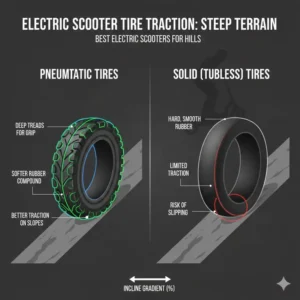
Tires: 10-inch solid (no flats!)
-
Rear Suspension: Dual shocks
-
-
Customer Review Analysis: Users appreciate the solid tires because they never have to deal with flats. The trade-off is a slightly stiffer ride. It’s a favorite for those with short, slightly hilly commutes.
-
Pros: Very affordable; low maintenance; great lighting.
-
Cons: Hill performance drops significantly if the rider is over 200 lbs; solid tires are slippery on wet metal.
-
Warranty: 12-month warranty.
-
Professional Applications: Ideal for short-range commuting and people who hate carrying a tire pump.
6. Dualtron Victor Luxury
When you talk about the best electric scooters for climbing hills, you eventually have to talk about Dualtron. The Dualtron Victor Luxury is a beast. It’s for the person who looks at a 30% incline and says, “Is that it?” This isn’t a toy; it’s a high-performance vehicle.
-
Technical Specifications:
-
Motor: 4000W Peak Dual Motors
-
Max Speed: 50 mph (check local laws!)
-
Range: 60 miles
-
Incline: 35%+ Grade
-
Brakes: Zoom Hydraulic + ABS
-
Battery: 60V 30Ah LG cells
-
-
Customer Review Analysis: “Terrifyingly fast” is a common sentiment. Experienced riders love the customizable suspension and the sheer power that never seems to bottom out on hills.
-
Pros: Unrivaled climbing power; high-quality LG battery cells; fully adjustable.
-
Cons: Extremely expensive; very heavy (70+ lbs); overkill for many.
-
Warranty: 6-month to 1-year limited.
-
Professional Applications: Long-range commuters and enthusiasts who live in “extreme” hill environments like the steepest streets of San Francisco.
7. Kaabo Wolf Warrior X GT
The Kaabo Wolf Warrior X GT is the best electric scooter for steep hills if those hills happen to be off-road or covered in gravel. With its dual-stem design, it’s built like a motorcycle. It offers stability that single-stem scooters simply can’t match when you’re fighting gravity.
-
Technical Specifications:
-
Motor: Dual 1100W
-
Max Speed: 43 mph
-
Range: 60 miles
-
Incline: 35% Grade
-
Tires: 10-inch All-terrain
-
Display: Full-color TFT screen
-
-
Customer Review Analysis: Owners love the “glued to the road” feeling. The sine-wave controllers make the acceleration smooth rather than jerky, which is vital when starting on an incline.
-
Pros: Rock-solid stability; great off-road capability; excellent lighting for night riding.
-
Cons: Large footprint; difficult to fit in a small trunk.
-
Warranty: 1-year limited warranty.
-
Professional Applications: Off-road enthusiasts and heavy-duty commuters.
✨ Don’t Miss These Exclusive Deals! 🔍
🔍 Take your commuting to the next level with these carefully selected products. Click on any highlighted item to check current pricing and availability. These scooters will help you conquer any hill your city throws at you! ✨
💬 Just one click – help others make better buying decisions too!😊
Detailed Technical Specifications Matrix
To help you decide which hill climbing electric scooter is right for your specific terrain, I’ve put together this detailed matrix. Remember, “Peak Power” is what helps you get up the hill, while “Nominal Power” is what the motor can sustain.
| Model | Battery Voltage | Motor Type | Weight | Max Payload | Folded Dimensions |
| Segway MAX G2 | 36V | Single Rear | 53 lbs | 265 lbs | 47.6 x 22.4 x 23.8 in |
| NIU KQi3 Max | 48V | Single Rear | 46 lbs | 265 lbs | 44.5 x 21.3 x 19.8 in |
| Apollo City 2024 | 48V | Dual Hub | 57 lbs | 265 lbs | 46.1 x 25.0 x 23.0 in |
| Gotrax GX1 | 48V | Dual Hub | 76 lbs | 300 lbs | 48.0 x 27.0 x 24.0 in |
| Hiboy S2 Pro | 36V | Single Front | 36 lbs | 220 lbs | 45.3 x 16.5 x 19.3 in |
| Dualtron Victor | 60V | Dual Hub | 73 lbs | 265 lbs | 44.7 x 10.9 x 22.0 in |
| Wolf Warrior X | 60V | Dual Hub | 75 lbs | 265 lbs | 47.6 x 11.0 x 18.9 in |
The Science of Climbing: Why Some Scooters Fail
I’ve spent a lot of time looking at motor controllers and battery discharge rates. Furthermore, I’ve realized that most people look at the wrong numbers. If you want the best electric scooters for hills, you have to look beyond just “Watts.”
1. Voltage is King
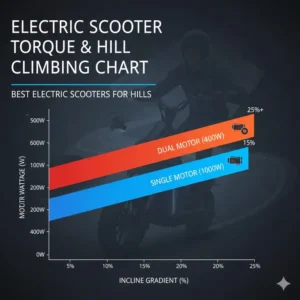
Think of voltage like the “pressure” in a garden hose. A 36V system is standard, but a 48V or 60V system provides more pressure to push through the resistance of a hill. This is why a 500W motor on a 48V system will almost always outperform a 500W motor on a 36V system when climbing hills on electric scooter.
2. Single vs. Dual Motors
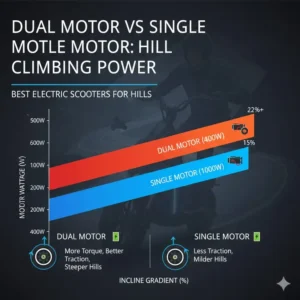
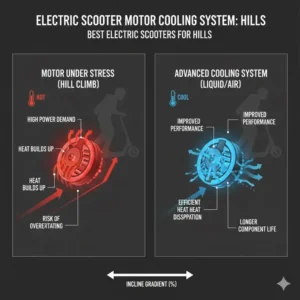
A single-motor scooter is like a car with two-wheel drive. It’s fine for most things. However, when you hit a steep, slippery incline, you want all-wheel drive. Dual motors split the workload, which prevents the motors from overheating. If you live in an area with hills steeper than a 15% grade, I strongly recommend a dual-motor e scooter for hills.
3. Controller Amperage
The controller is the “brain” that tells the battery how much power to send to the motor. High-quality controllers (like the Sine Wave controllers found in the Apollo City or Wolf Warrior) allow for a smooth flow of power. Consequently, you don’t get that “jerky” feeling when you start on an incline.
4. Tire Grip and Diameter
Ever tried to climb a hill in dress shoes? It’s hard. The same applies to scooters. Smaller 8.5-inch tires have to spin faster and have less contact with the ground. The best electric scooters for hills usually feature 10-inch or larger pneumatic tires. They provide the friction necessary to “grab” the pavement and pull you up.
Budget vs. Premium: What are you actually paying for?
| Feature | Budget ($500-$800) | Mid-Range ($800-$1,500) | Premium ($1,500+) |
| Hill Grade | 10-15% | 15-25% | 30% + |
| Suspension | None or Basic Spring | Hydraulic/Dual Spring | Fully Adjustable |
| Build Material | Basic Aluminum | High-Grade Alloy | Aerospace Grade/Carbon |
| Braking | Single Disc/E-Brake | Dual Disc | Dual Hydraulic with ABS |
| App Features | Basic Speedometer | GPS, Diagnostics, Lock | Full Telemetry & Customization |
Benefits of Choosing the Right Hill Climbing Electric Scooter
Choosing the right tool for the job changes your entire relationship with your city. Here is how a high-torque scooter compares to traditional urban transport.
| Benefit | Electric Scooter for Hills | Public Transit (Bus/Subway) | Car |
| Speed in Traffic | High (Bypass jams) | Low | Low |
| Predictability | High (You control time) | Low (Delays) | Medium |
| Cost Per Mile | < $0.01 | $2.50+ per trip | $0.60+ (IRS rate) |
| Parking | Free (Inside) | N/A | Expensive/Difficult |
| Environmental Impact | Zero Emissions | Medium | High |
Maintenance Tips for Hilly Terrain
Climbing hills puts a lot of stress on your machine. To keep your best electric scooters for hills running for years, you need to be a bit more proactive with maintenance.
-
Check Tire Pressure Weekly: Low pressure increases friction and makes the motor work harder, which kills your hill-climbing ability. I recommend keeping them at the higher end of the manufacturer’s suggested PSI (usually 45-50 PSI).
-
Monitor Brake Wear: What goes up must come down. Going down steep hills eats through brake pads. If you hear a “metal-on-metal” squeal, change them immediately!
-
Cool Down Periods: If you just climbed a massive hill and the deck feels hot, give the scooter 5-10 minutes before plugging it in to charge. This protects the battery’s longevity.
-
Tighten the Bolts: The vibration of high-torque motors can loosen the stem bolts over time. A quick check with an Allen wrench once a month is a life-saver.
“The efficiency of a brushless DC motor significantly drops as heat increases; therefore, maintaining proper airflow and avoiding constant peak-power operation is essential for longevity.”
Performance Metrics: Real World Hill Climbing
| Grade (%) | Angle (Degrees) | Typical 500W Scooter Speed | Typical 1000W Scooter Speed | Typical 4000W Scooter Speed |
| 5% | 2.8° | 15 mph | 18 mph | 45 mph |
| 10% | 5.7° | 10 mph | 15 mph | 40 mph |
| 15% | 8.5° | 5 mph | 12 mph | 35 mph |
| 20% | 11.3° | Stalls | 8 mph | 30 mph |
| 30% | 16.7° | No Chance | Stalls | 20 mph |
Safety Requirements for High-Torque Riding
If you are buying a scooter for hills, you are essentially buying a high-performance vehicle. You need to treat it with respect.
-
Helmet is Mandatory: Not a “cool” accessory, a requirement. On hills, you are often moving faster than average bike speeds.
-
Leaning Forward: When climbing, lean your weight over the front handlebars. This keeps the front wheel planted and prevents the scooter from flipping backward (looping out).
-
Braking Technique: Use the rear brake first, then the front. On steep descents, “pump” the brakes rather than holding them down to prevent overheating the rotors.
-
Visibility: Use high-visibility gear. Car drivers often don’t expect a scooter to be moving at 20 mph uphill.
Requirements Analysis Table
| Rider Weight | Target Hill Grade | Recommended Min. Power | Recommended Voltage |
| 150 lbs | 10% | 350W | 36V |
| 150 lbs | 20% | 500W | 48V |
| 220 lbs | 10% | 500W | 48V |
| 220 lbs | 20% | 1000W (Dual) | 48V or 52V |
| 250+ lbs | 20%+ | 1200W+ (Dual) | 60V |
Exploring Variations: Finding Your Specific Match
When people search for the best electric scooters for hills, they are often looking for very specific things. Some want a trampline 14 ft style of bounce in their suspension, while others want a scooter for hills that can fold small enough to fit in a locker.
If you are looking for best electric scooters for climbing hills on a budget, the Hiboy S2 Pro is the winner. If you need a best electric scooter for steep hills (like 30% or more), you simply cannot compromise—you need a Dualtron or a Kaabo.
One common typo I see is people looking for “best electric scootrs for hills.” Regardless of the spelling, the physics remains the same. You need torque. Torque is the rotational force that turns the wheel against the resistance of gravity. While horsepower wins races on the flats, torque wins the battle against the hill.
For those looking at 14 foot trampoline sized decks, the Wolf Warrior offers the most foot space, which is crucial for shifting your weight during a climb. On the other hand, the Segway MAX G2 offers a more compact form factor for those who need to carry their ride up the stairs after the hill is conquered.
Benefits of Hill-Optimized Scooters
-
Reliability: These scooters use higher-grade components that don’t burn out.
-
Safety: Better brakes mean better control on the way down.
-
Time Savings: No more walking your scooter up the last block of your commute.
-
Confidence: Knowing your machine can handle the terrain reduces riding anxiety.
✨ Ready to crush those hills?
Click on your favorite model above to see the latest deals on Amazon and start your high-torque adventure today! 🚴♂️
Conclusion: Conquering the Incline
Finding the best electric scooters for hills comes down to understanding your specific environment and your weight. If you’re a lightweight rider in a city with moderate slopes, something like the NIU KQi3 Max or Segway MAX G2 will be your best friend. They are reliable, relatively portable, and have enough “zip” to keep you moving.
However, if you are tackling the “vertical” streets of a city like San Francisco, or if you simply want the most powerful ride possible, the Dualtron Victor Luxury or the Kaabo Wolf Warrior X GT are the clear winners. These machines represent the pinnacle of 2026 scooter technology, offering torque that was unthinkable just a few years ago.
Don’t let a hill stand in the way of your freedom. With the right scooter, that “hill of doom” becomes just another fun part of your commute. Happy riding!
FAQs
✅ For steep hills (over 15% grade), a motor with at least 1000W peak power is recommended. Dual-motor setups are even better, as they distribute the load and provide better traction on inclines without overheating the system...
✅ Yes, but riders over 220 lbs should look for 48V or 60V systems with dual motors. A single 350W motor will likely stall or crawl at walking speeds for heavier individuals on anything above a 10% incline...
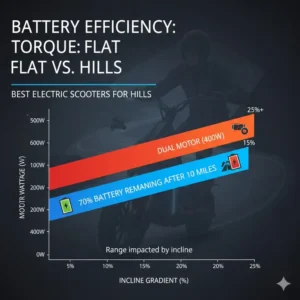
✅ Absolutely. Climbing hills requires significantly more current from the battery, which can reduce your total range by 30-50% if your entire route is hilly. Always plan for extra battery capacity if you live in a hilly city...
✅ It is safe if the scooter has high-quality disc or hydraulic brakes. You should never rely solely on an electronic brake for steep descents, as they can fail if the battery is fully charged (due to overvoltage protection)...
✅ Rear-wheel drive is generally better for climbing as your weight shifts to the back, increasing traction. However, dual-wheel drive (AWD) is the absolute gold standard for hills, providing the most grip and power distribution available... ❓ What is the best watt motor for climbing steep hills?
❓ Can a heavy rider use an electric scooter on hills?
❓ Do hills drain the electric scooter battery faster?
❓ Is it safe to ride an electric scooter down a steep hill?
❓ Which is better for hills: front or rear wheel drive?
Recommended for You
- Fat Tire Scooters for Sale: Top 7 Expert-Rated Models for 2026!
- Best Fat Tire Scooter: Top 7 Power-Packed Rides for 2026
- Electric Scooter with Shocks: 7 Best Smooth-Riding Picks for 2026
Disclaimer: This article contains affiliate links. If you purchase products through these links, we may earn a small commission at no additional cost to you.
✨ Found this helpful? Share it with your friends! 💬🤗