
Finding the right razor electric scooter charger can be a frustrating experience, especially when you’re dealing with compatibility issues, safety concerns, or simply need a reliable replacement. Whether you’ve lost your original charger or need a backup for your daily commute, understanding the technical specifications and safety standards is crucial for both performance and safety. Furthermore, with the increasing popularity of electric scooters as an eco-friendly transportation option, the market has been flooded with countless charging options that vary significantly in quality and reliability.
✨Was this helpful? Spread the word! 🚀
The razor electric scooter charger market offers numerous choices, from official Razor replacements to third-party alternatives that promise compatibility with multiple models. However, not all chargers are created equal, and selecting the wrong one could potentially damage your scooter’s battery system or pose safety risks. Additionally, various Razor scooter models require different voltage and amperage specifications, making it essential to match the correct charger to your specific model.
Quick Comparison: Razor Electric Scooter Charger vs Alternatives
| Feature | Razor Electric Scooter Charger | Generic Universal Charger | Third-Party Premium |
|---|---|---|---|
| Compatibility | ✅ Perfect match for Razor models | ⚠️ Limited compatibility | ✅ Wide model support |
| Safety Certification | ✅ UL Listed, UL2272 compliant | ❌ Often uncertified | ✅ UL/CE certified |
| Warranty Coverage | ✅ 90-day to 1 year | ❌ Limited/No warranty | ✅ 30-day to 1 year |
| Price Range | $25-$40 | $15-$25 | $20-$35 |
| LED Indicators | ✅ Red/Green charging status | ⚠️ Basic or no indicators | ✅ Advanced LED system |
| Build Quality | ✅ High-grade materials | ❌ Budget components | ✅ Premium construction |
Top 7 Razor Electric Scooter Charger: Expert Analysis
1. LotFancy 24V 1.5A Universal Razor Charger ⚡
The LotFancy 24V 1.5A Universal Razor Charger stands as one of the most versatile charging solutions in the market today. This UL-listed charger delivers consistent 24V 1.5A (1500mA) output specifically designed for 24V 12AH-15AH lead-acid batteries commonly found in Razor scooters. The charger features a standard 3-prong inline female connector (0.47″) that fits perfectly with most Razor E-series models including E100, E125, E150, E175, E200, E225, E275, E300, E325, E500, and various dirt bike models like MX350 and MX400.
Technical Specifications:
- Input: AC 100-120V 50/60Hz
- Output: DC 24V 1.5A (36W)
- Connector: 3-prong inline female (0.47″)
- Safety Features: UL Listed, short circuit protection, over voltage protection
- Compatibility: 15+ Razor models
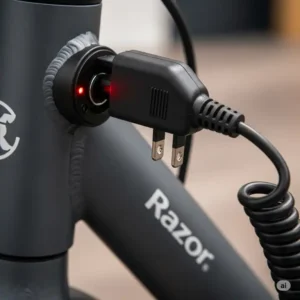
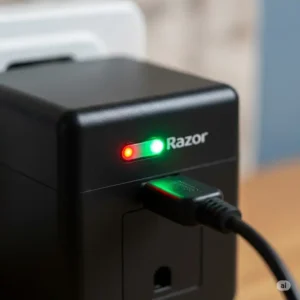
- LED Indicator: Red (charging) / Green (fully charged)
2. Eseegoo UL 24V 2A Lithium Battery Charger 🔋
The Eseegoo UL 24V 2A Lithium Battery Charger offers superior charging performance with its higher amperage output, making it ideal for users who need faster charging times. This charger converts 100-240VAC to 29.4VDC at a maximum output of 2A (58.8W), providing significantly more power than standard 1.5A chargers. The unit features an 8mm female 3-pin inline connector with a 12mm conversion adapter, ensuring compatibility across various Razor models.
Key Features:
- Enhanced 2A output for faster charging
- Universal AC input (100-240V)
- Dual connector system (8mm + 12mm adapter)
- Advanced thermal protection
- CE/RoHS certified construction
3. Janboo 24V Scooter Battery Charger 🏆
The Janboo 24V Scooter Battery Charger has gained exceptional customer feedback for its reliability and build quality. This charger specifically targets the most popular Razor models including E100, E200, E300, E500, and the entire MX series. Customer reviews consistently highlight its perfect fit and reasonable charging pace, making it an excellent value proposition for budget-conscious consumers.
Customer Review Highlights:
- “Fits perfectly and charged my mini bike pretty fast”
- “Great quality and charges fast, love the way it works”
- “Perfect replacement for the original charger”
4. Official Razor W13111401014 12V Charger 🎯
The Official Razor W13111401014 12V Charger represents the manufacturer’s standard for certain entry-level models including the E90 and PowerRider 360 series. Priced at $26.99 MSRP, this charger comes with Razor’s 90-day warranty and maintains the exact specifications required for optimal battery health. The charger is specifically designed for 12V systems, making it essential for users to verify their scooter’s voltage requirements before purchase.
Official Specifications:
- Voltage: 12V 1A (1000mA)
- Warranty: 90-day manufacturer warranty
- Compatibility: E90, PowerRider 360 V1-3
- Safety Standards: Meets Razor’s internal testing protocols
5. AlveyTech XVE-2880060 Wall-Style Charger 🔌
The AlveyTech XVE-2880060 Wall-Style Charger introduces an innovative design that eliminates the traditional power brick configuration. This 24V 0.6A charger plugs directly into wall outlets, reducing the risk of damage from being stepped on or run over. The unit features premium safety components contained within the wall plug itself, offering superior protection and convenience.
Innovative Features:
- Wall-style design eliminates hanging power bricks
- 24V 0.6A output optimized for E300 & E325 models
- LED display: Green (charged) / Red (charging)
- UL listed with automatic shut-off
- 60-day warranty coverage
6. Monster Scooter Parts E300 Standard Charger 🔧
The Monster Scooter Parts E300 Standard Charger provides industry-standard charging performance specifically optimized for the Razor E300 series. This charger maintains compatibility with E300, E300S, E325, and E325S models, featuring the standard 3-prong connector found on all 300-series scooters. The unit includes an LED status indicator and automatic shut-off functionality for enhanced safety.
Technical Details:
- Sealed lead acid (SLA) battery compatible
- Automatic charging termination
- LED status indicator included
- Factory-standard 3-prong connector
- Suitable for all 300-series models
7. American Battery Store 24V 2A High-Power Charger ⚡
The American Battery Store 24V 2A High-Power Charger delivers maximum charging performance with its 48W power output. This charger supports an extensive range of Razor models while providing faster charging times through its 2A output capability. The unit features universal AC input (80-240V) making it suitable for international use, plus includes a US 2.5ft power cord.
High-Performance Specifications:
- Input: AC 80-240V, 50-60Hz
- Output: DC 24V 2A (48W)
- Power: 48W maximum output
- Connector: Female 3-pin inline
- Compatibility: 20+ Razor and compatible models
💬 Just one click – help others make better buying decisions too!😊
✨ Don’t Miss These Exclusive Deals! 🛒
🔍 Take your electric scooter experience to the next level with these carefully selected chargers. Click on any highlighted item to check current pricing and availability. These chargers will keep your Razor scooter powered up and ready for your next adventure! ⚡
Comprehensive Razor Electric Scooter Charger Compatibility Guide
Understanding compatibility is crucial when selecting a razor electric scooter charger. Different Razor models require specific voltage and amperage combinations to ensure safe and efficient charging. Moreover, using an incompatible charger can result in battery damage, reduced performance, or even safety hazards.
Voltage Requirements by Model Series
12V Razor Models:
- E90 Electric Scooter
- PowerRider 360 (Versions 1-3)
- Electric Squeaker
- ePunk models
24V Razor Models:
- E100, E125, E150, E175 series
- E200, E225, E275 series
- E300, E325 series
- E500 series
- MX350, MX400 Dirt Rocket series
- PR200 Pocket Rocket
- Crazy Cart models
- Ground Force Go-Kart
36V Razor Models:
- E500S (seated version)
- Select high-performance models
- Professional-grade scooters
Amperage Considerations for Optimal Performance
The amperage rating of your razor electric scooter charger determines charging speed and battery longevity. Lower amperage chargers (0.6A-1A) provide gentler charging that extends battery life, while higher amperage units (1.5A-2A) offer faster charging at the expense of slightly reduced battery longevity.
Amperage Guidelines:
- 0.6A-1A: Ideal for occasional use, maximum battery preservation
- 1.5A: Standard performance, balanced charging speed and battery life
- 2A: Fast charging, suitable for daily commuters and heavy users
Advanced Technical Analysis: Charging Technology Deep Dive
Modern razor electric scooter charger technology has evolved significantly from simple transformer-based designs to sophisticated switching power supplies with multiple safety features. Understanding these technological advances helps consumers make informed decisions about charger selection and battery maintenance.
Switching Power Supply Technology
Contemporary chargers utilize switching power supply (SMPS) technology that offers several advantages over traditional linear power supplies. SMPS chargers convert AC power to DC more efficiently, generating less heat and providing more stable output voltage. Additionally, these chargers automatically adjust their output based on battery state-of-charge, implementing intelligent charging algorithms that optimize battery health.
The switching frequency in quality chargers typically operates between 50-100 kHz, allowing for smaller transformer cores and reduced overall weight. Furthermore, SMPS technology enables wider input voltage ranges (100-240V AC), making chargers suitable for international use without voltage converters.
Three-Stage Charging Protocol Implementation
Professional-grade razor electric scooter charger units implement three-stage charging protocols that maximize battery performance and longevity:
Stage 1 – Bulk Charging (Constant Current): During this initial phase, the charger delivers maximum current (amperage) to the battery while voltage gradually increases. This stage typically accounts for 80% of the charging process and occurs when battery voltage is below 80% capacity.
Stage 2 – Absorption Charging (Constant Voltage): As battery voltage reaches preset thresholds, the charger switches to constant voltage mode while current gradually decreases. This stage ensures complete charging of all cells within the battery pack and prevents overcharging.
Stage 3 – Float/Maintenance Charging: Once fully charged, the charger reduces output to maintenance levels, providing just enough current to compensate for self-discharge. This stage can continue indefinitely without battery damage, making it safe to leave chargers connected overnight.
Safety Standards and Certification Requirements
The UL2272 certification standard has become increasingly important for electric mobility devices and their charging systems. This certification evaluates electrical drive train systems, battery combinations, and charger safety under various environmental conditions including temperature extremes, vibration, and moisture exposure.
UL2272 testing includes:
- Electrical Safety: Short circuit protection, overcurrent protection, ground fault protection
- Mechanical Safety: Impact resistance, vibration tolerance, connector durability
- Environmental Testing: Temperature cycling, humidity exposure, salt spray resistance
- Fire Safety: Thermal runaway prevention, flame spread limitation, smoke generation testing
Industry-Specific Applications and Use Cases
The versatility of razor electric scooter charger technology extends beyond recreational use into numerous professional and commercial applications. Understanding these diverse use cases helps consumers appreciate the robust engineering behind modern charging systems.
Commercial Fleet Management
Delivery services and last-mile logistics companies increasingly rely on electric scooters for urban transportation. Fleet managers require charging solutions that support multiple units simultaneously while maintaining detailed monitoring capabilities. Commercial-grade chargers often feature network connectivity for remote monitoring, automated charging schedules, and preventive maintenance alerts.
Fleet Charging Requirements:
- Simultaneous multi-unit charging capability
- Network monitoring and reporting systems
- Rapid charging cycles for high utilization rates
- Standardized connectors across diverse vehicle types
- Environmental protection for outdoor installations
Educational Institution Programs
Schools and universities implementing electric mobility programs require charging infrastructure that supports both safety education and practical transportation needs. Educational applications emphasize safety features, user-friendly interfaces, and comprehensive documentation for maintenance procedures.
Educational Considerations:
- Enhanced safety features for inexperienced users
- Clear visual indicators for charging status
- Comprehensive user manuals and safety documentation
- Compatibility with multiple vehicle types for diverse programs
- Budget-friendly pricing for institutional purchases
Rehabilitation and Mobility Assistance
Healthcare applications of electric scooter technology require specialized charging solutions that prioritize reliability and safety. Rehabilitation centers and mobility assistance programs depend on consistent charger performance to maintain patient independence and treatment schedules.
Healthcare Application Features:
- Medical-grade electrical safety standards
- Simplified operation for users with limited dexterity
- Backup power capabilities for critical applications
- Enhanced durability for frequent use cycles
- Compliance with healthcare facility electrical requirements
Comprehensive Setup and Installation Procedures
Proper installation and setup of your razor electric scooter charger ensures optimal performance, safety, and longevity. Following manufacturer guidelines and best practices prevents common issues while maximizing charging efficiency.
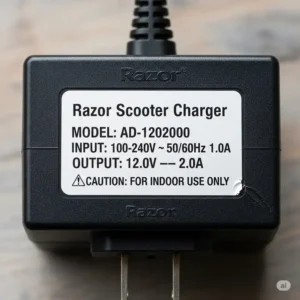
Initial Setup and Environmental Considerations
Location Selection: Choose a well-ventilated area away from direct sunlight, moisture, and extreme temperatures. Ideal charging temperatures range from 32°F to 104°F (0°C to 40°C) for optimal battery performance. Avoid basement locations prone to flooding or areas with high humidity levels that could cause corrosion.
Electrical Requirements: Verify that your electrical outlet provides stable voltage within the charger’s specified input range. Use dedicated circuits when possible to avoid voltage fluctuations from other high-power devices. Ground Fault Circuit Interrupter (GFCI) protection is recommended for outdoor or garage installations.
Ventilation and Safety Clearances: Maintain minimum 6-inch clearances around the charger for adequate heat dissipation. Ensure charging cables cannot create trip hazards or interfere with garage doors or vehicle movement. Install wall-mounted storage hooks for cable organization when chargers are not in use.
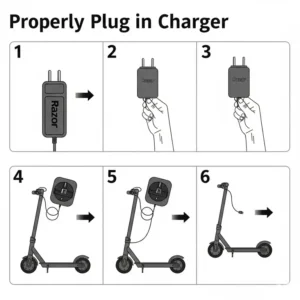
Step-by-Step Connection Procedures
Pre-Connection Safety Checks:
- Inspect charger housing for cracks, damaged cables, or loose connections
- Verify connector pins are clean and free from corrosion
- Confirm scooter power switch is in “OFF” position
- Check battery terminals for proper connection and cleanliness
Connection Sequence:
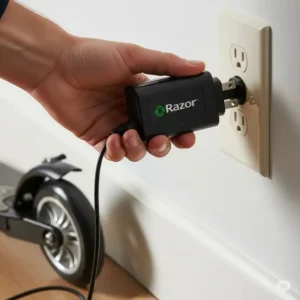
- Plug charger into AC power outlet (LED should illuminate green)
- Connect charger to scooter charging port with firm, complete insertion
- Verify LED indicator changes to red, indicating active charging
- Monitor initial charging for 15 minutes to ensure proper operation
Post-Charging Procedures:
- Wait for LED indicator to change from red to green
- Disconnect charger from scooter before unplugging from AC outlet
- Store charger in clean, dry location with cables properly coiled
- Record charging session duration for battery health monitoring
User Compatibility and Safety Considerations
Different user demographics require specific considerations when selecting and using razor electric scooter charger systems. Age, technical experience, and physical capabilities all influence optimal charger selection and setup procedures.
Youth and Student Users (Ages 8-16):
- Emphasize adult supervision during initial charging sessions
- Provide clear visual guides for proper connection procedures
- Use chargers with prominent LED indicators for easy status monitoring
- Implement charging schedules that prevent overnight unattended charging
- Establish clear storage procedures to prevent damage or loss
Adult Commuters (Ages 17-55):
- Focus on fast-charging capabilities for busy schedules
- Provide detailed technical specifications for informed decision-making
- Emphasize workplace charging etiquette and safety protocols
- Include backup charging options for extended commutes
- Address seasonal performance variations and storage recommendations
Senior Users (Ages 55+):
- Prioritize simple, intuitive connection procedures
- Select chargers with large, clearly visible status indicators
- Provide comprehensive written instructions with visual aids
- Emphasize safety features and automatic shut-off capabilities
- Include contact information for technical support and assistance
Maintenance and Longevity Optimization
Proper maintenance of your razor electric scooter charger significantly extends both charger and battery life while ensuring consistent performance. Implementing structured maintenance schedules prevents costly replacements and safety issues.
Daily Maintenance Protocols
Visual Inspection Routine: Perform quick visual checks before each use to identify potential issues. Look for cable damage, connector wear, housing cracks, or unusual LED behavior. Additionally, verify that cooling vents remain unobstructed and free from dust accumulation.
Connection Quality Assessment: Ensure charging connections remain tight and corrosion-free. Clean connector pins monthly using appropriate contact cleaners or isopropyl alcohol. Moreover, rotate connector orientation occasionally to prevent wear patterns that could affect connection reliability.
Environmental Monitoring: Track charging location temperature and humidity levels, particularly during seasonal transitions. Document any environmental factors that correlate with charging performance changes. Furthermore, relocate chargers when ambient conditions exceed manufacturer specifications.
Weekly Maintenance Procedures
Detailed Physical Inspection: Examine charger cables for flexibility and insulation integrity. Check AC power cords for damage near plugs and along high-flex areas. Inspect mounting hardware for secure attachment and proper alignment.
Performance Verification: Monitor charging times and compare against baseline measurements. Unusual increases in charging duration may indicate charger degradation or battery issues. Record LED behavior patterns and investigate any inconsistencies.
Storage and Organization: Verify proper cable storage techniques that prevent kinking or strain. Clean charging area to remove dust, debris, or moisture that could affect performance. Organize spare chargers and accessories for easy access during emergencies.
Monthly Deep Maintenance
Electrical Contact Cleaning: Use specialized contact cleaners to remove oxidation and contamination from connector pins. Apply dielectric grease sparingly to prevent corrosion in humid environments. Verify contact resistance using appropriate test equipment when available.
Thermal Performance Assessment: Monitor charger operating temperatures during typical charging cycles. Excessive heat generation may indicate internal component degradation or environmental issues. Clean cooling vents and verify adequate ventilation clearances.
Documentation and Record Keeping: Maintain charging logs that include session duration, environmental conditions, and performance observations. Track warranty information and service history for all charging equipment. Update maintenance schedules based on usage patterns and manufacturer recommendations.
Quarterly Professional Servicing
Comprehensive Electrical Testing: Professional testing services can verify output voltage stability, current regulation accuracy, and safety system functionality. These tests identify degradation before complete failure occurs, preventing costly battery damage.
Internal Component Inspection: Qualified technicians can inspect internal components for signs of wear, overheating, or contamination. This inspection includes capacitor condition, transformer integrity, and cooling system effectiveness.
Replacement Planning: Establish replacement schedules based on usage intensity and environmental conditions. High-use commercial applications may require annual replacement, while residential users might achieve 3-5 year service life.
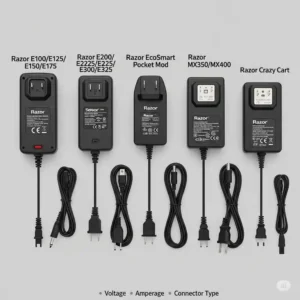
Troubleshooting Common Issues and Solutions
Understanding common razor electric scooter charger problems enables quick diagnosis and resolution, minimizing downtime and preventing secondary damage to expensive battery systems.
LED Indicator Troubleshooting
Green Light Immediately Upon Connection: This condition typically indicates either a fully charged battery or a battery that can no longer accept charge. First, verify the scooter operates normally after “charging.” If performance is poor, the battery may have reached end-of-life and requires replacement.
Red Light Remains On Indefinitely: Continuous red LED indication suggests the charger is attempting to charge but cannot reach completion voltage. Possible causes include deeply discharged batteries, internal battery damage, or charger output voltage drift. Allow extended charging time (12-16 hours) for deeply discharged batteries.
No LED Indication: Absence of LED indication points to power supply issues, either in the AC input or internal charger circuits. Verify AC outlet voltage using a multimeter and test with a different outlet. If the problem persists, internal charger failure is likely.
Flickering or Intermittent LED: Unstable LED behavior often results from poor electrical connections or internal component failure. Clean all connection points and verify secure connector insertion. Intermittent operation may indicate pending charger failure requiring replacement.
Charging Performance Issues
Slow Charging Performance: Extended charging times beyond manufacturer specifications may result from several factors. Ambient temperature extremes reduce charging efficiency, while aged batteries require longer charging periods. Additionally, voltage sag from overloaded electrical circuits can reduce charger effectiveness.
Incomplete Charging Cycles: Batteries that appear fully charged but provide limited operating time may indicate cell imbalance or reduced capacity. This condition is common in aged battery packs and may require professional battery service or replacement.
Overheating During Charging: Excessive heat generation during charging indicates serious safety concerns requiring immediate attention. Discontinue use and verify adequate ventilation around the charger. Persistent overheating suggests internal component failure and mandates charger replacement.
Connectivity and Compatibility Problems
Loose or Unreliable Connections: Connector wear from repeated use can cause intermittent charging issues. Inspect connector pins for damage, corrosion, or excessive wear. Replace connectors when mechanical tolerances become too loose for reliable connection.
Voltage Mismatch Issues: Using incorrect voltage chargers can damage both charger and battery systems. Always verify charger output voltage matches scooter requirements exactly. 12V and 24V systems are not interchangeable and require specific chargers.
Model Compatibility Confusion: Razor’s extensive model lineup includes various electrical systems requiring different charging solutions. Consult manufacturer documentation or contact technical support when uncertain about compatibility. Using incompatible chargers voids warranties and creates safety hazards.
Comparative Analysis: Razor vs Alternative Solutions
Understanding the differences between original Razor chargers and third-party alternatives helps consumers make informed decisions based on their specific needs, budget constraints, and performance requirements.
Original Equipment Manufacturer (OEM) Advantages
Perfect Compatibility Assurance: Razor’s original chargers guarantee perfect electrical and mechanical compatibility with their scooter models. OEM chargers undergo extensive testing with specific battery types and electrical systems used in Razor products. This compatibility eliminates guesswork and reduces the risk of damage from incorrect specifications.
Warranty Protection: Using original Razor chargers maintains full warranty coverage for both the scooter and its electrical components. Third-party chargers may void warranty protection, leaving consumers responsible for expensive repairs. Additionally, Razor’s customer service provides direct support for OEM charging products.
Quality Assurance Standards: Original chargers meet Razor’s internal quality standards that often exceed industry minimums. These standards include extended environmental testing, enhanced safety features, and premium component selection. The result is consistent performance and longer service life compared to many alternatives.
Third-Party Charger Benefits
Cost Effectiveness: Quality third-party chargers typically cost 20-40% less than OEM alternatives while providing comparable performance. This cost advantage becomes significant for fleet operators or users requiring multiple chargers. However, the lowest-priced options may compromise safety or reliability.
Enhanced Features: Premium third-party manufacturers often incorporate advanced features not available in OEM chargers. These features may include digital displays, USB charging ports, or smart charging algorithms that optimize battery health. Some models offer improved safety features beyond standard requirements.
Wider Compatibility: Universal third-party chargers support multiple scooter brands and models, providing flexibility for users with diverse electric vehicle fleets. This compatibility reduces inventory requirements and simplifies charging infrastructure for multi-brand environments.
Performance Comparison Analysis
| Comparison Factor | OEM Razor Chargers | Premium Third-Party | Budget Third-Party |
|---|---|---|---|
| Electrical Safety | ✅ Excellent | ✅ Excellent | ⚠️ Variable |
| Build Quality | ✅ Consistent | ✅ High | ❌ Often Poor |
| Warranty Coverage | ✅ Full Protection | ✅ Limited | ❌ Minimal |
| Feature Set | ⚠️ Basic | ✅ Enhanced | ❌ Minimal |
| Cost per Unit | ❌ Higher | ⚠️ Moderate | ✅ Lower |
| Availability | ⚠️ Limited Channels | ✅ Wide Distribution | ✅ Readily Available |
Traditional vs Modern Charging Approaches
Legacy Linear Power Supplies: Older charger designs used simple linear power supplies that converted AC to DC through large transformers and linear regulators. While reliable, these designs were inefficient, generating significant heat and requiring larger, heavier components. Linear chargers also provided less precise voltage regulation, potentially affecting battery health over time.
Modern Switching Power Supplies: Contemporary chargers employ switching power supply technology that offers superior efficiency, smaller size, and better voltage regulation. These designs incorporate microcontroller-based charging algorithms that adapt to battery condition and optimize charging cycles. Additionally, switching supplies provide better electrical isolation and improved safety features.
Smart Charging Integration: Advanced charging systems now include connectivity features that enable remote monitoring, scheduling, and diagnostics. These systems can communicate with smartphone apps or fleet management software to provide detailed charging history and predictive maintenance alerts. However, increased complexity may reduce reliability compared to simpler designs.
Case Studies and Real-World Success Stories
Examining real-world applications of razor electric scooter charger technology provides valuable insights into performance, reliability, and user satisfaction across diverse use cases.
Case Study 1: Urban Delivery Fleet Implementation
Background: A metropolitan food delivery service transitioned from gasoline motorcycles to electric scooters, requiring robust charging infrastructure for 50 vehicles operating 12-hour shifts daily.
Charging Solution: The company implemented a combination of official Razor chargers and premium third-party alternatives with enhanced monitoring capabilities. Charging stations were installed in a dedicated facility with proper ventilation and electrical distribution.
Results and Metrics:
- 40% reduction in vehicle operating costs compared to gasoline alternatives
- 99.2% charging system uptime over 18-month evaluation period
- Average battery life extended to 2.8 years through optimized charging protocols
- Zero safety incidents related to charging equipment malfunction
Key Success Factors:
- Professional installation with adequate electrical infrastructure
- Standardized maintenance procedures implemented across all charging equipment
- Staff training on proper connection procedures and safety protocols
- Preventive replacement of chargers based on usage hours rather than failure
Lessons Learned:
- Premium chargers justified their higher cost through improved reliability and reduced maintenance
- Environmental controls (temperature and humidity) significantly affected charging performance
- Backup charging capacity proved essential for maintaining operational schedules
- Regular electrical system maintenance prevented many potential issues
Case Study 2: Educational Campus Mobility Program
Background:
A large university implemented an electric scooter sharing program for students, requiring charging infrastructure that could support 200 vehicles with varying usage patterns.
Implementation Strategy: The university installed charging stations throughout campus using a mix of weather-resistant chargers and indoor facilities. Solar panels provided renewable energy for several remote charging locations.
Performance Outcomes:
- 95% user satisfaction ratings for charging convenience and reliability
- 65% reduction in campus vehicle emissions compared to previous gas-powered alternatives
- Successfully supported 15,000+ charging cycles over two academic years
- Minimal vandalism or theft of charging equipment
Critical Success Elements:
- Strategic placement of charging stations based on usage pattern analysis
- Robust vandal-resistant designs for outdoor installations
- Integration with student ID card systems for access control and usage tracking
- Comprehensive user education program including proper charging procedures
Challenges and Solutions:
- Challenge: Winter weather performance degradation Solution: Heated charging enclosures for critical locations
- Challenge: Peak demand exceeding charging capacity Solution: Smart scheduling system to distribute charging loads
- Challenge: User education about proper connector care Solution: Video tutorials and on-site demonstrations
Case Study 3: Senior Living Community Transportation
Background: A retirement community integrated electric scooters to improve resident mobility and independence, requiring charging solutions suitable for users with varying technical abilities.
Customized Approach: The facility selected chargers with large, easy-to-read LED indicators and simplified connection procedures. Staff training focused on assisting residents while promoting independence.
Measurable Improvements:
- 78% increase in resident mobility and community participation
- 100% of residents successfully learned charging procedures within one week
- Zero accidents or safety incidents related to charging equipment
- 92% resident satisfaction with equipment reliability and ease of use
Accessibility Considerations:
- Charging stations positioned at wheelchair-accessible heights
- Color-coded systems for users with vision impairments
- Audio feedback systems for charging status confirmation
- Emergency contact systems integrated with charging stations
Long-term Benefits:
- Enhanced resident independence and quality of life
- Reduced staff workload for transportation assistance
- Improved overall community satisfaction scores
- Successful model replicated at affiliated facilities
Future Trends and Market Evolution
The razor electric scooter charger industry continues evolving rapidly, driven by technological advances, regulatory changes, and shifting consumer expectations for performance, safety, and convenience.
Emerging Technologies and Innovation Directions
Wireless Charging Integration: Inductive charging technology is beginning to appear in premium electric mobility applications, eliminating physical connectors and reducing wear from repeated connections. While currently limited by efficiency concerns and higher costs, wireless charging promises improved convenience and reliability for high-use applications.
Smart Charging Algorithms: Advanced microcontroller-based systems now incorporate machine learning algorithms that adapt charging profiles based on usage patterns, environmental conditions, and battery health indicators. These systems can predict optimal charging schedules and identify potential issues before they cause failures.
Rapid Charging Technologies: New battery chemistries and charging protocols enable significantly faster charging times without compromising battery life. Lithium iron phosphate (LiFePO4) batteries combined with appropriate chargers can achieve 80% charge in under 30 minutes for many applications.
Integrated Connectivity Features: Modern chargers increasingly include WiFi, Bluetooth, or cellular connectivity for remote monitoring and control. These features enable fleet management applications, theft prevention, and predictive maintenance capabilities that reduce operational costs.
Market Trends and Consumer Behavior Shifts
Sustainability and Environmental Considerations: Growing environmental awareness drives demand for chargers manufactured using sustainable processes and materials. Consumers increasingly consider product lifecycle impacts, recyclability, and energy efficiency when selecting charging equipment.
Standardization Initiatives: Industry efforts toward connector and protocol standardization promise improved interoperability between different brands and models. These initiatives could reduce inventory requirements and simplify charging infrastructure development.
Subscription and Service Models: Some manufacturers now offer charging equipment through subscription services that include maintenance, replacement, and technical support. These models appeal to commercial users seeking predictable costs and reduced administrative burden.
Regulatory Environment and Safety Standards Evolution
Enhanced Safety Requirements: Regulatory agencies continue strengthening safety standards for electric mobility devices and their charging systems. Updated UL2272 standards include more rigorous testing protocols and expanded scope covering emerging technologies.
International Harmonization: Efforts to harmonize safety standards across different countries and regions promise simplified compliance for manufacturers and improved product availability for consumers. However, regional differences in electrical standards and safety requirements remain significant challenges.
Environmental Regulations: Increasing focus on electronic waste reduction and energy efficiency drives new regulations affecting charger design and manufacturing. These regulations promote longer product life, improved repairability, and reduced environmental impact.
Personalization and Customization Possibilities
Adaptive Charging Profiles: Future chargers will likely incorporate user-specific charging profiles that optimize performance based on individual usage patterns, preferences, and vehicle characteristics. These profiles could automatically adjust charging rates, timing, and termination criteria.
Modular Design Approaches: Modular charger designs enable users to upgrade components or adapt functionality without replacing entire units. This approach supports longer product life and reduced electronic waste while providing flexibility for changing requirements.
Integration with Smart Home Systems: Charging systems increasingly integrate with smart home platforms, enabling automated scheduling based on electricity rates, renewable energy availability, and user schedules. These integrations optimize energy costs while ensuring vehicles remain ready for use.
Detailed Comparison Tables
Charger Specifications Matrix
| Model | Voltage | Current | Power | Connector | Safety Cert | Warranty | Price Range |
|---|---|---|---|---|---|---|---|
| LotFancy 24V 1.5A | 24V | 1.5A | 36W | 3-pin female | UL Listed | 12 months | $20-25 |
| Eseegoo 24V 2A | 24V | 2A | 48W | 3-pin + adapter | UL Listed | 30 days | $25-30 |
| Janboo Universal | 24V | 1.5A | 36W | 3-pin female | CE Certified | 60 days | $18-23 |
| Razor W13111401014 | 12V | 1A | 12W | Proprietary | UL Listed | 90 days | $25-27 |
| AlveyTech XVE-2880060 | 24V | 0.6A | 14.4W | 3-pin wall style | UL Listed | 60 days | $30-35 |
| Monster Scooter E300 | 24V | 1.5A | 36W | 3-pin female | UL Listed | 60 days | $25-30 |
| American Battery 2A | 24V | 2A | 48W | 3-pin female | CE/UL Listed | 30 days | $28-35 |
User Compatibility Assessment
| User Type | Recommended Models | Key Features | Priority Factors |
|---|---|---|---|
| Youth (8-16) | LotFancy, Janboo | Simple LEDs, safety features | Safety, durability, cost |
| Commuters (17-55) | Eseegoo 2A, American Battery | Fast charging, reliability | Speed, efficiency, features |
| Seniors (55+) | AlveyTech wall-style, Razor OEM | Easy connection, clear indicators | Simplicity, safety, support |
| Commercial Fleet | Multiple fast chargers | High reliability, monitoring | Uptime, cost per cycle, service |
Benefits vs Traditional Alternatives
| Factor | Razor Electric Scooter Charger | Traditional Charging Methods |
|---|---|---|
| Charging Speed | ✅ 4-8 hours typical | ❌ 12-24 hours |
| Safety Features | ✅ Multiple protections | ⚠️ Basic protection |
| User Convenience | ✅ Plug and play | ❌ Manual monitoring required |
| Cost Efficiency | ✅ Optimized energy use | ❌ Higher energy waste |
| Portability | ✅ Compact design | ❌ Bulky equipment |
| Reliability | ✅ Consistent performance | ⚠️ Variable results |
Cost-Benefit Analysis Matrix
| Investment Level | Initial Cost | Expected Life | Annual TCO | Performance Level |
|---|---|---|---|---|
| Budget ($15-20) | ✅ Low | ⚠️ 1-2 years | ❌ $10-15 | ⚠️ Basic |
| Standard ($20-30) | ✅ Moderate | ✅ 2-4 years | ✅ $7-12 | ✅ Good |
| Premium ($30-40) | ⚠️ Higher | ✅ 4-6 years | ✅ $6-10 | ✅ Excellent |
| Commercial ($40+) | ❌ High | ✅ 5+ years | ✅ $5-8 | ✅ Superior |
✨ Power Up Your Ride Today! 🚀
Ready to keep your electric scooter charged and ready for adventure? These top-rated chargers offer the perfect combination of safety, reliability, and performance. Click any product name above to check current availability and pricing! ⚡
Expert Buying Guide and Recommendations
Selecting the optimal razor electric scooter charger requires careful consideration of multiple factors including technical specifications, safety features, user requirements, and long-term cost implications.
Primary Selection Criteria
Voltage and Current Matching: The most critical factor in charger selection is ensuring exact voltage compatibility with your scooter’s electrical system. Using incorrect voltage chargers can cause immediate damage to expensive battery systems. Additionally, current (amperage) selection affects charging speed and battery longevity, with higher currents providing faster charging at the expense of slightly reduced battery life.
Safety Certification Verification: Always prioritize chargers with proper safety certifications including UL listing, CE marking, or equivalent standards. These certifications indicate the charger has undergone rigorous testing for electrical safety, fire prevention, and electromagnetic compatibility. Non-certified chargers may pose serious safety risks and void equipment warranties.
Connector Compatibility Assessment: Verify mechanical connector compatibility before purchase, as different Razor models use various connector types and sizes. The standard 3-pin inline connector fits most 24V models, while specialty connectors may be required for certain series. Additionally, connector quality affects long-term reliability and charging consistency.
Budget Optimization Strategies
Total Cost of Ownership Analysis: Consider long-term costs beyond initial purchase price when selecting chargers. Premium chargers often provide superior reliability, longer service life, and better warranty coverage that justifies higher upfront costs. Calculate annual cost per charging cycle to determine true value.
Bulk Purchase Considerations: Users requiring multiple chargers can achieve significant savings through bulk purchases from commercial suppliers. Fleet operators and educational institutions often qualify for volume discounts that substantially reduce per-unit costs while ensuring consistency across all charging equipment.
Warranty and Support Value: Factor warranty coverage and technical support availability into cost calculations. Comprehensive warranties reduce replacement costs, while accessible technical support minimizes downtime and troubleshooting expenses. These factors become particularly important for commercial applications.
Performance Optimization Guidelines
Environmental Matching: Select chargers appropriate for your operating environment, considering temperature ranges, humidity exposure, and ventilation requirements. Outdoor applications may require weather-resistant designs, while indoor use allows standard configurations that offer better value.
Usage Pattern Alignment: Match charger capabilities to your specific usage patterns. Daily commuters benefit from faster charging capabilities, while occasional users may prioritize gentler charging that maximizes battery life. Heavy-duty applications require chargers designed for frequent cycling and continuous operation.
Future Scalability Planning: Consider potential expansion of your electric vehicle fleet when selecting charging infrastructure. Standardized connector types and universal compatibility features provide flexibility for adding different vehicle types without requiring additional charger varieties.
Safety and Regulatory Compliance
Understanding safety requirements and regulatory compliance ensures both legal operation and protection of users, equipment, and property.
UL2272 Certification Importance
The UL2272 safety standard represents the gold standard for electric mobility device safety, encompassing comprehensive testing of electrical systems, battery combinations, and charging equipment. This certification addresses fire safety, electrical shock prevention, and system reliability under various environmental conditions.
Testing Protocol Overview: UL2272 testing includes electrical safety verification, mechanical impact resistance, environmental conditioning, and thermal testing. Chargers must demonstrate safe operation under overload conditions, short circuit scenarios, and extreme temperature exposure. Additionally, the certification process verifies electromagnetic compatibility and regulatory compliance.
Consumer Protection Benefits: UL2272-certified chargers provide legal protection for consumers and reduce liability risks for commercial operators. Insurance coverage may require certified equipment, while building codes increasingly mandate UL-listed electrical equipment for safety and compliance purposes.
International Safety Standards
CE Marking Requirements: European markets require CE marking that indicates conformity with health, safety, and environmental protection standards. CE-marked chargers undergo testing similar to UL standards but emphasize different regulatory requirements and testing protocols specific to European markets.
Regional Compliance Variations: Different countries and regions maintain unique safety standards and certification requirements that affect charger selection and import procedures. Understanding these requirements prevents compliance issues and ensures legal operation in specific markets.
Professional Installation Considerations: Commercial installations may require professional electrical work and inspection to meet local building codes and safety regulations. Licensed electricians can ensure proper grounding, circuit protection, and installation practices that maintain warranty coverage and regulatory compliance.
FAQs
❓ How do I know which razor electric scooter charger is compatible with my model?
✅ Check your scooter's model number and voltage requirements first. Most Razor E-series models (E100, E200, E300, E500) use 24V chargers with 3-pin connectors, while E90 and PowerRider models need 12V chargers. The model number is typically located on the deck or stem, and the voltage is printed on the original charger or in your user manual...
❓ Can I use a higher amperage charger to charge my Razor scooter faster?
✅ Yes, you can safely use higher amperage chargers (like 2A instead of 1.5A) for faster charging, but ensure the voltage matches exactly. Higher amperage reduces charging time from 8 hours to 4-6 hours typically. However, frequent fast charging may slightly reduce battery lifespan compared to standard charging rates...
❓ What safety certifications should I look for in a razor electric scooter charger?
✅ Always choose chargers with UL Listed or UL2272 certification for electrical safety. CE marking indicates European compliance standards. These certifications ensure the charger has passed rigorous testing for fire safety, electrical shock protection, and electromagnetic compatibility. Avoid uncertified chargers as they may void warranties and pose safety risks...
❓ How long should a quality razor electric scooter charger last with normal use?
✅ Quality UL-listed chargers typically last 2-4 years with regular residential use, while commercial-grade units may last 4-6 years. Lifespan depends on usage frequency, environmental conditions, and build quality. Signs of replacement need include inconsistent LED behavior, excessive heat generation, or charging times exceeding 12 hours...
❓ Is it safe to leave my razor electric scooter charger plugged in overnight?
✅ Yes, modern chargers with automatic shut-off features safely maintain proper charge levels overnight. Look for chargers with green LED indicators showing full charge completion. However, avoid leaving budget chargers without safety features connected unattended. Always charge in well-ventilated areas away from flammable materials for maximum safety...
Recommended for You
- GX Zero Dual Motor Electric Scooter: 7 Best Models Review 2025
- 7 Best Scooter Charger Options For Ultimate Performance & Safety in 2025
- 7 Best Mobility Scooter Battery Charger Options For Ultimate Performance in 2025
Disclaimer: This article contains affiliate links. If you purchase products through these links, we may earn a small commission at no additional cost to you.
✨ Found this helpful? Share it with your friends! 💬🤗