Have you ever walked out of your house, ready to zip through the morning air on your way to work, only to find your electric ride as dead as a doornail? It is a heartbreaking moment. I have been there myself—standing on the sidewalk, staring at a blank display screen while the clock ticks closer to my first meeting. The culprit? Usually, it is not the scooter itself, but a failing or inefficient charging setup. Finding the right scooter battery chargers is the difference between a seamless commute and an Uber ride of shame.
✨Was this helpful? Spread the word! 🚀
In this massive 2026 guide, I am going to walk you through everything you need to know about keeping your wheels turning. We are not just looking at plastic boxes with wires; we are looking at the lifeblood of your micro-mobility lifestyle. Whether you are rocking a lightweight folder or a heavy-duty commuter, the right charging unit for electric scooter needs is non-negotiable for battery longevity.
Before we dive into the deep technical specs, let’s look at how specialized scooter battery chargers stack up against the “universal” junk you might find in a bargain bin.
Quick Comparison: Dedicated Chargers vs. Alternatives
| Feature | Dedicated Scooter Battery Chargers | Universal Power Adapters | USB-C PD (High Wattage) |
| Voltage Accuracy | 100% Match (e.g., 42V for 36V) | Variable (Dangerous) | Incompatible with most |
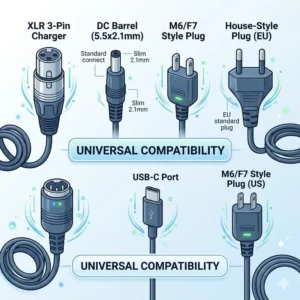
| Connector Type | Specific (GX16, XLR, RCA) | Interchangeable (Loose) | Not supported |
| Overcharge Protection | Integrated BMS Communication | Minimal to None | N/A |
| Heat Management | High (Active or Passive cooling) | Low (Prone to melting) | Moderate |
| Battery Life Impact | Preserves longevity | Can cause “cooking” | N/A |
Top 7 Scooter Battery Chargers: Expert Analysis
Choosing a charger for scooter battery needs is not a one-size-fits-all situation. I have researched the top-performing units currently available on Amazon and through reputable distributors to bring you the best of the best for 2026.
1. Gotrax 42V 2.0A Standard Charger
This is the gold standard for anyone riding a 36V lithium-ion system, particularly the Gotrax GXL and Ultra series. It is a no-frills, reliable workhorse that does exactly what it says on the tin.
-
Technical Specifications:
-
Output: 42V 2.0A
-
Input: 100-240V AC, 50/60Hz
-
Connector: 8mm DC Barrel Plug
-
Certification: UL Listed, CE, RoHS
-
-
Customer Review Analysis: Users consistently praise its “silent operation” and the fact that it doesn’t get as hot as the generic versions. One reviewer noted, “It’s been a year and it still tops off my GXL in about 4 hours every single day.”
-
Warranty: 6-month limited manufacturer warranty.
-
Pros: Very affordable, compact design, UL safety certified.
-
Cons: Not suitable for larger 48V or 60V systems; 2A speed is slow for high-capacity batteries.
2. Razor 24V 1.5A Battery Charger (3-Prong Inline)
If you have a kid with a Razor E100, E300, or a Pocket Mod, this moped charger is likely the one you need. It uses a specific 3-prong connector that ensures a secure fit.
-
Technical Specifications:
-
Output: 24V 1.5A
-
Connector: 3-Prong Female Inline (Standard Razor)
-
Charging Time: 8-12 hours for a full cycle
-
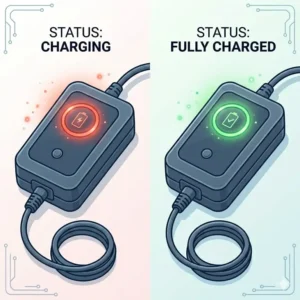
Indicator: Dual-color LED (Red/Green)
-
-
Customer Review Analysis: Parents love the simplicity. A common sentiment is, “Saved us from buying a whole new scooter when the original dog chewed the cord.” However, some mention the long charge times due to the lower amperage.
-
Warranty: 90-day warranty via Razor USA.
-
Pros: OEM reliability, sturdy cable housing, prevents overcharging of lead-acid batteries.
-
Cons: Only works with 24V systems; proprietary plug limits versatility.
3. YZPOWER 42V 5A High-Speed Charger
Now we are getting into the “Pro” territory. This is a premium electric moped charger designed for those who don’t want to wait 8 hours for a recharge.
-
Technical Specifications:
-
Output: 42V 5A (High Current)
-
Connector: XLR or GX16 (User-selectable options)
-
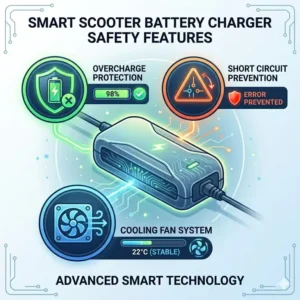
Cooling: Integrated high-speed cooling fan
-
Casing: Aluminum alloy for heat dissipation
-
-
Customer Review Analysis: Highly rated by enthusiasts. Users say, “This thing is a beast. My 15Ah battery goes from 20% to 100% in less than 3 hours.” A few users mentioned the fan noise can be loud in a quiet room.
-
Warranty: 1-year replacement guarantee.
-
Pros: Extremely fast, durable metal build, excellent safety sensors.
-
Cons: Expensive; the fan makes it less portable; requires a high-quality BMS on the scooter side.
4. LotFancy 24V 2.0A Lead-Acid Charger
A fantastic budget option for older mobility scooters and small electric bikes that utilize SLA (Sealed Lead Acid) batteries. It is a versatile moped charger that fits many brands like Schwinn and Izip.
-
Technical Specifications:
-
Output: 24V 2.0A
-
Connector: 3-Pin XLR
-
Protection: Short circuit, overvoltage, over-current
-
Stages: 3-stage smart charging (Constant current, Constant voltage, Float)
-
-
Customer Review Analysis: Celebrated for its value. “Cheaper than the original and works better. The float mode keeps my batteries fresh over winter,” says one verified buyer.
-
Warranty: 1-year manufacturer warranty.
-
Pros: Great for long-term storage (float mode), very cheap, works with mobility aids.
-
Cons: Not for Lithium batteries; plastic casing feels a bit flimsy.
5. MIGHTY MAX 24V 5A Smart Charger
This is a heavy-duty charging unit for electric scooter enthusiasts who use larger seated mopeds or heavy-duty mobility devices. It provides a punchy 5-amp current for 24V systems.
-
Technical Specifications:
-
Output: 24V 5.0A
-
Connector: 3-Pin XLR (Standard for mobility scooters)
-
Technology: Smart MCU control to prevent overheating
-
Cable Length: 6 feet
-
-
Customer Review Analysis: Known for its longevity. Reviewers highlight its ability to “revive” batteries that had been sitting for a while (though this is not guaranteed). One user remarked, “It’s solid and heavy, which usually means good components inside.”
-
Warranty: 1-year full warranty.
-
Pros: High output for 24V systems, professional-grade build, works on many brands (Pride, Drive).
-
Cons: Bulky; not meant for lightweight kick-scooters.
6. EVO 36V 1.6A Charger with RCA Plug
A specialty scooter battery charger designed for specific older models of e-bikes and scooters that utilize the RCA-style port.
-
Technical Specifications:
-
Output: 36V (Actually 42V peak) 1.6A
-
Connector: RCA Male (looks like an old audio plug)
-
Input: 110V US Standard
-
Indicator: Simple Red/Green LED
-
-
Customer Review Analysis: Users find it helpful because this specific plug is getting harder to find. “Perfect match for my old Schwinn S500,” one user wrote. Some complain the RCA pin is fragile.
-
Warranty: 6-month limited warranty.
-
Pros: Hard-to-find connector, lightweight, reliable 3-stage charging.
-
Cons: Fragile connector pin; very low amperage (slow charging).
7. T-Power 42V Charger for Segway Ninebot
If you own a Segway ES1, ES2, or Max, you want something that matches the high quality of those machines. This third-party scooter batteries charger is one of the most trusted alternatives to the official Segway brick.
-
Technical Specifications:
-
Output: 42V 2.0A
-
Connector: Specialized Segway/Ninebot 2-prong connector
-
Safety: Over-temperature and short-circuit protection
-
Cord: Extra-long 10ft total reach
-
-
Customer Review Analysis: Dominates the Segway replacement market. “Better than the original because of the long cord,” says one top reviewer.
-
Warranty: 1-year extended warranty.
-
Pros: Long cable, specifically tuned for Segway BMS, very stable voltage.
-
Cons: Only fits Segway/Ninebot proprietary ports.
Detailed Comparison: Top 7 Spec Matrix
| Product Name | Voltage (V) | Amperage (A) | Connector Type | Best For |
| Gotrax 42V | 42 | 2.0 | 8mm DC Barrel | Commuter Scooters |
| Razor 24V | 24 | 1.5 | 3-Prong Female | Kids’ Scooters |
| YZPOWER 42V | 42 | 5.0 | XLR/GX16 | Performance/Fast Charge |
| LotFancy 24V | 24 | 2.0 | 3-Pin XLR | Mobility/Budget |
| MIGHTY MAX 24V | 24 | 5.0 | 3-Pin XLR | Heavy Duty Mopeds |
| EVO 36V | 36 | 1.6 | RCA Male | Legacy E-bikes |
| T-Power 42V | 42 | 2.0 | Segway Plug | Ninebot/Segway Max |
🛍️ Don’t Miss These Exclusive Deals!
🔍 Elevate your riding experience with these carefully selected scooter battery chargers. Click on any of the products listed above to check current pricing and availability. Having a backup charger at the office or in your backpack ensures you are never stranded! ⚡
💬 Just one click – help others make better buying decisions too! 😊
Deep Dive: The Science of Scooter Battery Chargers
When we talk about scooter battery chargers, we are really talking about the management of ions moving through a chemical medium. Most modern scooters use Lithium-ion (Li-ion) batteries, while older or larger ones might use Sealed Lead Acid (SLA). The way a charging unit for electric scooter handles these two chemistries is vastly different.
How a Charging Unit for Electric Scooter Works
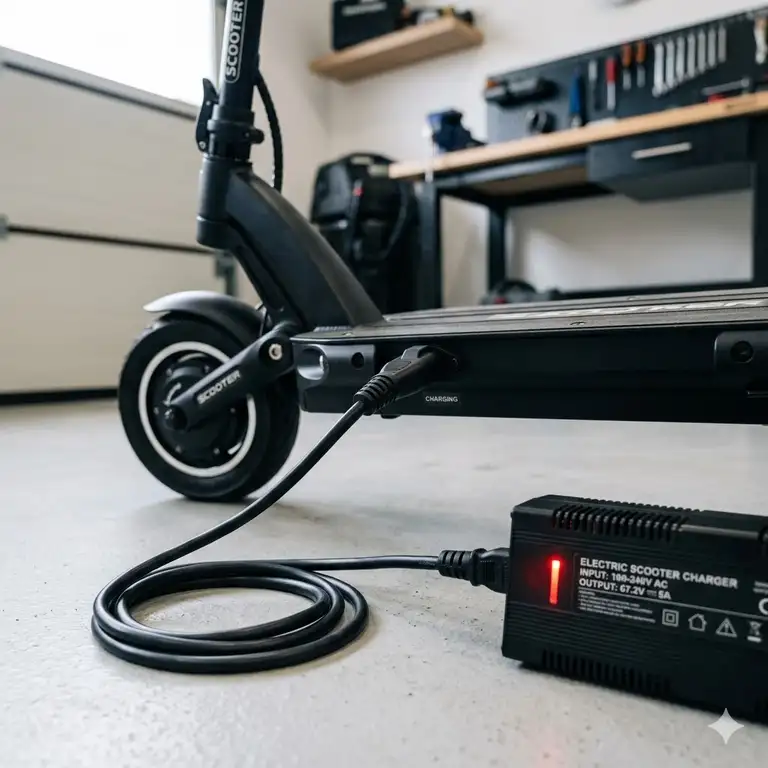
A charger’s job is to take the 110V or 220V AC (Alternating Current) from your wall and convert it into a steady DC (Direct Current) voltage that your battery can handle. It doesn’t just “shove” electricity into the battery. It follows a curve:
-
Bulk Stage: The charger provides a constant current until the battery voltage reaches a set level.
-
Absorption Stage: The voltage stays constant, and the current slowly drops as the battery fills up.
-
Termination/Float: For lithium, it simply cuts off. For lead-acid, it might drop to a “trickle” to keep it topped off.
Using a generic power brick that isn’t designed as a scootter battery chargers unit is dangerous because it may not have the “Absorption” or “Termination” stages. This can lead to thermal runaway—a fancy term for your battery catching fire. I have seen photos of melted decks, and trust me, you don’t want that in your garage.
Performance Metrics: Quantifying the Benefits
| Metric | High-Quality Charger | Cheap Generic Knock-off |
| Voltage Ripple | < 100mV (Clean power) | > 500mV (Stresses battery) |
| Efficiency Rating | > 85% (Less wasted heat) | < 70% (Wastes energy) |
| Safety Sensors | Temp & Short Circuit | Fuse only (or nothing) |
| Connector Quality | Tight fit, high-grade pins | Loose, prone to arcing |
The Electric Moped Charger: More Than Just a Kick-Scooter Plug
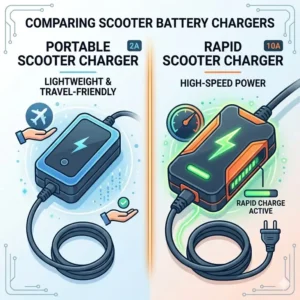
When you move into the world of seated scooters, you often hear the term electric moped charger. These are usually more robust. Mopeds often have larger battery packs (measured in Amp-hours or Ah), which means they need more current to charge in a reasonable amount of time.
While a small kick-scooter might have a 5Ah or 7Ah battery, an electric moped might have a 20Ah or 30Ah pack. If you use a standard 2A scooter battery charger on a 30Ah moped, you will be waiting 15 hours for a charge. That is why moped chargers typically start at 5A and go up to 10A or higher.
Compatibility Guide for Moped Chargers
| Moped Battery Type | Ideal Charging Current | Common Plug Type |
| 48V 15Ah Li-ion | 3A – 5A | GX16 3-pin |
| 60V 20Ah Li-ion | 5A – 8A | XLR or C13 |
| 24V 20Ah Lead-Acid | 2A – 5A | 3-Pin XLR |
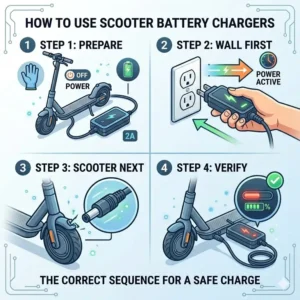
Technical Features: What to Look for in a Charger for Scooter Battery
When you are browsing for a scooter charger battery, don’t just look at the price tag. I recommend focusing on three main pillars: Voltage, Amperage, and Safety Certifications.
1. Voltage (The Push)
Your charger’s output voltage must match your battery’s nominal voltage.
-
24V Systems: Usually require a 29.2V (LiFePO4) or 28.8V (Lead Acid) output.
-
36V Systems: Usually require a 42V output.
-
48V Systems: Usually require a 54.6V output.
-
60V Systems: Usually require a 67.2V output.
If you use a 42V charger on a 24V battery, you will literally fry the cells. It is like trying to fill a balloon with a firehose.
2. Amperage (The Flow)
Higher amperage means faster charging. However, your battery has a “maximum charge rate.” Most commuter scooters shouldn’t be charged faster than 2A or 3A unless the manual specifically says “Fast Charge Compatible.” Pushing too much current can generate internal heat and degrade the battery’s lifespan.
3. Safety (The Brains)
Look for a scootter battery chargers unit that is UL Listed. Underwriters Laboratories (UL) tests these devices for fire safety. In 2026, with the increase in battery-related incidents, many cities in the USA (like New York) actually require UL-certified chargers by law for indoor storage.
Feature Comparison Matrix
| Feature | Budget ($15-$25) | Mid-Range ($25-$60) | Premium ($60-$120) |
| Cooling | Passive (Plastic Vents) | Passive (Heatsinks) | Active (Internal Fan) |
| Housing | Thin Plastic | Heavy-Duty ABS | Aluminum Alloy |
| LED Indicators | Single LED | Dual LED | LCD Display with % |
| Safety Certs | CE/FCC | UL / RoHS | TUV / UL / Energy Star |
Benefits of Upgrading Your Moped Charger
Why spend $80 on a premium moped charger when the $20 one works? Well, I like to think of it like this: would you put 87-octane gas in a Ferrari? A high-quality charging unit for electric scooter maintenance provides benefits that aren’t immediately visible.
Benefit Comparison: Premium vs. Standard
| Benefit Category | Standard Charger | Premium High-Amp Charger |
| Charging Speed | 6-10 Hours | 2-4 Hours |
| Battery Life | Average (Rougher cycles) | Extended (Smooth CC/CV curve) |
| Heat Management | Runs hot to the touch | Stays cool (Protecting internals) |
| Portability | Lightweight/Flimsy | Weighted/Durable |
| Smart Tech | Basic Cut-off | Temperature Monitoring |
By investing in a better charger for scooter battery health, you are actually saving money in the long run. Replacing a $300-$500 lithium battery pack is much more painful than buying a decent $50 charger.
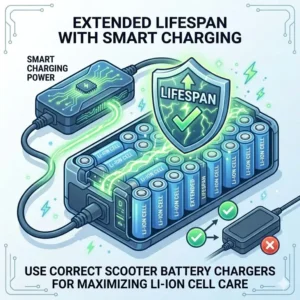
Common Mistakes When Using Scooter Battery Chargers
I have made plenty of mistakes in my time, and some have cost me dearly. Here is a quick checklist of what not to do with your scooter charger battery setup.
-
Leaving it plugged in for weeks: Even though most chargers have an “auto-shutoff,” it is still a risk. Once the green light is on, unplug it.
-
Charging in extreme cold/heat: Lithium batteries hate being charged below 32°F or above 110°F. If you just rode through the snow, let the scooter warm up to room temperature first.
-
Using a “Fast Charger” every day: Use the fast electric moped charger when you are in a rush, but use a standard 2A charger overnight to preserve battery health.
-
Ignoring a frayed cable: If you see copper, throw it away. Arcing is the #1 cause of e-scooter fires.
Requirements Analysis: Which Charger Do You Need?
| Your Scooter Type | Battery Capacity | Recommended Charger Specs |
| Kids/Toy (e.g. Razor) | < 10Ah Lead Acid | 24V 1.5A |
| Commuter (e.g. Gotrax/Xiaomi) | 7Ah – 12Ah Lithium | 42V 2.0A |
| High Performance (e.g. Apollo/Voro) | 15Ah – 25Ah Lithium | 52V/60V 5.0A |
| Heavy Moped / Mobility | 20Ah+ Lead/Lithium | 24V/48V 5.0A – 8.0A |
Troubleshooting Your Scooter Charger Battery
If your charger isn’t working, don’t panic. Here is my personal “triage” list for scooter batteries charger issues:
-
The “Dead Brick”: If the light doesn’t turn on when plugged into the wall (and not the scooter), the internal fuse is likely blown. Replace the charger.
-
The “Stays Green” Issue: If the light is green but the scooter is dead, your charger isn’t “seeing” the battery. This could be a blown fuse inside the scooter or a disconnected wire at the charging port.
-
The “Flashing Red” Light: This usually indicates a fault—either a short circuit or the battery voltage is too low for the charger to recognize it safely.
-
The “Hot Brick”: If it’s too hot to touch, unplug it immediately. This indicates an internal component failure or a charger that is being pushed past its amperage limit.
Cost Comparison: DIY Repair vs. Replacement
| Component | Estimated Repair Cost | Replacement Cost | Recommendation |
| Broken Charging Port | $10 (Part) + $30 (Labor) | N/A | Repair |
| Frayed Charging Cord | $5 (Solder/Tape) | $25 (New Charger) | Replace (Safety First!) |
| Blown Internal Fuse | $2 (Part) | $25 (New Charger) | Replace if not tech-savvy |
| Battery Replacement | $200 – $600 | N/A | Maintain with good charger |
🔍 Don’t Miss These Exclusive Deals!
Click on any of our top-rated scooter battery chargers above to see current prices on Amazon. Most of these items are eligible for fast shipping, so you can be back on the road by tomorrow! Don’t wait until your current charger dies—having a spare is the smartest move a rider can make. 🛴✨
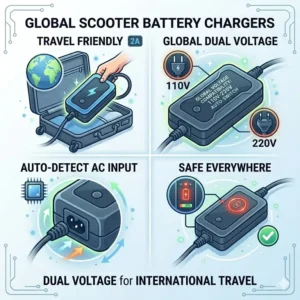
Conclusion: Don’t Let a Bad Charger Ground You
In the grand scheme of things, scooter battery chargers might seem like a boring purchase. But when you think about it, that little black brick is the only thing standing between you and a 10-mile walk. By understanding the difference between a cheap knock-off and a high-quality charging unit for electric scooter maintenance, you protect your investment, your safety, and your sanity.
Remember to always double-check your voltage, look for those UL certifications, and never—ever—buy a charger that “almost” fits the port. Your scooter (and your house) will thank you.
Whether you’re looking for a lightning-fast electric moped charger or just a reliable moped charger for your kid’s weekend fun, I hope this guide has illuminated the path to the perfect power source.
FAQs
✅ Yes, a 42V charger is actually the standard for a 36V lithium-ion battery system. The 42V represents the 'peak' voltage when fully charged, while 36V is the nominal voltage. Always ensure the connector pins match perfectly before use...
✅ It's normal for chargers to feel warm, but they shouldn't be too hot to touch. Heat is generated during the AC-to-DC conversion process. If it's burning hot, your charger might be under-powered or lacking proper ventilation or heat sinks...
✅ Charging time depends on the battery capacity (Ah) and charger output (A). For a 20Ah moped battery using a 5A moped charger, it typically takes 4-5 hours. Using a slower 2A charger would increase that time to 10+ hours...
✅ While most modern units have an automatic cut-off, it is best practice to unplug them once charged. Continuous connection can lead to minor 'trickle' stresses or fire risks if the charger's internal safety circuitry fails over time...
✅ Generally, yes, as long as the voltage, polarity, and connector type match exactly. However, high-end scooters often have a Battery Management System (BMS) that communicates specifically with the charger, so OEM replacements are usually the safest bet... ❓ Can I use a 42V charger on a 36V electric scooter?
❓ Why does my scooter battery charger get extremely hot during use?
❓ How long should it take to charge a standard electric moped?
❓ Is it safe to leave my charger plugged in after the light turns green?
❓ Can I use a different brand charger if the voltage and pins are the same?
Recommended for You:
- Fastest Scooter Under 1000: 7 Best Value Speed Machines for Smart Riders
- 7 Best Ways to Replace Mobility Scooter Battery: 2026 Expert Guide
- 7 Best Electric Scooter for Female in 2026: Top Rated Picks!
Disclaimer: This article contains affiliate links. If you purchase products through these links, we may earn a small commission at no additional cost to you.
✨ Found this helpful? Share it with your friends! 💬🤗