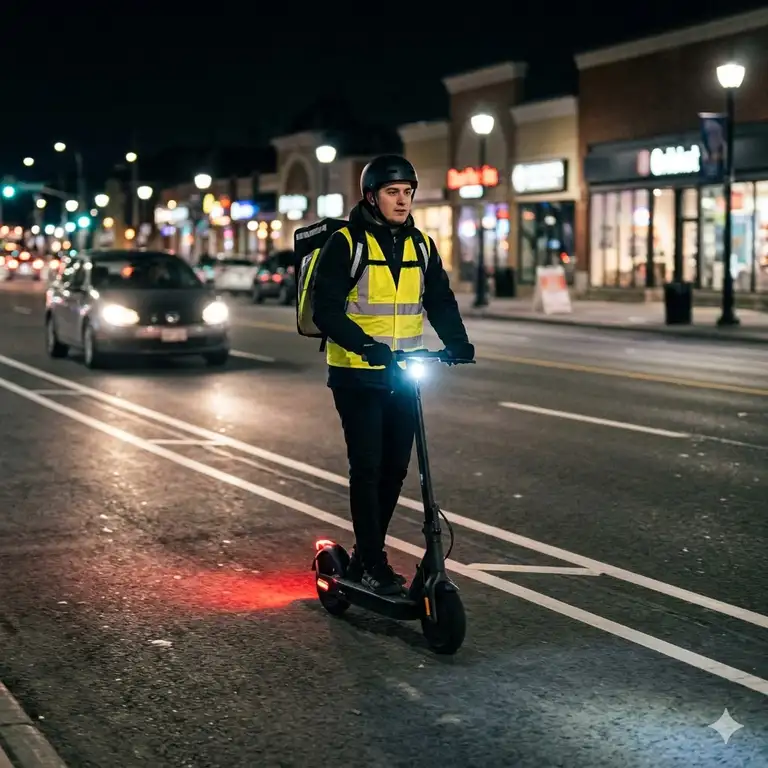
When we talk about how to ride scooter at night safely, we are referring to a multi-layered strategy that combines active illumination, passive visibility, and defensive maneuvering to mitigate the inherent risks of low-light urban environments. It isn’t just about flicking on a headlight; it’s about creating a “visibility envelope” that ensures you are seen by distracted drivers from all 360 degrees. As electric micromobility becomes the backbone of American city transit in 2026, the density of traffic has increased, making these safety protocols more vital than ever.
In my years of testing various micromobility platforms, I’ve found that the transition from dusk to full dark is the most dangerous window. Shadows stretch, depth perception falters, and the glare from oncoming LED high-beams can temporarily blind even the most seasoned rider. To truly master how to ride scooter at night safely, you must shift your mindset from “I can see” to “Can they see me?” This guide breaks down the essential gear, the tactical maneuvers, and the psychological prep required to own the road after the sun sets.
Whether you are a late-shift worker commuting home or a weekend explorer enjoying the cooler night air, understanding the technical nuances of your equipment is the first step toward a hazard-free journey. We aren’t just looking at specs; we are looking at how those specs keep you upright when a surprise pothole emerges from the gloom.
Quick Comparison: Top Safety Gear for Night Riding
| Product Category | Top Recommendation | Primary Benefit | Best For | Price Range |
| All-in-One Scooter | Segway Ninebot Max G2 | Integrated Turn Signals | Daily Commuters | Around $900 |
| High-Power Light | Cygolite Metro Pro 1100 | 1100 Lumens Output | Unlit Bike Paths | $70 – $95 |
| Smart Helmet | Lumos Ultra Smart | Eye-Level Indicators | Urban Navigators | $110 – $140 |
| Reflective Gear | Proviz Reflect360 Jacket | 360° Silver Reflectivity | Maximum Visibility | $120 – $160 |
| Secondary Lighting | Serfas Thunderbolt 2.0 | Peripheral Illumination | Side-Profile Safety | $40 – $55 |
Expert Data Analysis: The table above highlights that safety is a tiered investment. While the Segway Ninebot Max G2 offers the best “built-in” solution for those who want a ready-to-ride package, riders on unlit suburban trails should prioritize an external light like the Cygolite Metro Pro 1100. Notice how the Proviz Reflect360 fills the “passive” safety gap that electronics alone cannot solve, especially if your battery fails mid-ride.
💬 Just one click — help others make better buying decisions too!😊
Top 5 Safety Products for Night Riding: Expert Analysis
1. Segway Ninebot Max G2 (Advanced Night Commuter)
The Segway Ninebot Max G2 represents the pinnacle of integrated safety for the 2026 rider. Unlike older models that treated lighting as an afterthought, this scooter features front and rear integrated turn signals and a high-intensity 2.1W LED headlight.
The inclusion of built-in turn signals is a game-changer for how to ride scooter at night safely. In my experience, taking your hands off the handlebars to give a manual signal at night is a recipe for a wipeout; the G2 allows you to keep both hands on the grips while communicating your intent to drivers. The 1000W peak power motor isn’t just for speed—it provides the torque needed to quickly clear intersections, which is where most nighttime accidents occur.
Buyers often overlook the G2’s hydraulic front suspension. At night, shadows hide surface irregularities; a suspension system that can absorb a “hidden” 2-inch drop is the difference between staying on the deck and a nasty fall. According to Wikipedia’s entry on Electric Scooters, stability is a primary safety factor, and the G2’s wide 10-inch self-healing tires provide that in spades.
-
Pros: Integrated blinkers for better communication, self-healing tires reduce roadside repair risks, excellent suspension for hidden bumps.
-
Cons: Heavier than “last-mile” models, price is in the premium bracket.
-
Price Range: $850 – $999.
-
Value Verdict: The best choice for serious commuters who value integrated tech over add-on accessories.
2. Cygolite Metro Pro 1100 (Professional Grade Headlight)
When the built-in light on your scooter just doesn’t cut it, the Cygolite Metro Pro 1100 offers a blistering 1100 lumens of light. This isn’t just about being bright; it’s about the “beam throw”—the ability to see 50 feet ahead rather than just 10.
What most buyers overlook is the “Daylight Visible Flash” mode. While this is a night riding guide, this feature is essential for those “Blue Hour” periods when the sun is down but the sky isn’t pitch black yet. The 1100-lumen output is powerful enough to illuminate deep potholes in total darkness, a feat most stock scooter lights fail at. I recommend mounting this as high as possible on the stem to broaden the field of vision.
The aluminum heat-sink casing is vital. Cheaper plastic lights often overheat and dim automatically after 20 minutes of use. The Metro Pro maintains its brightness, ensuring your return trip is as safe as your departure. Many customer reviews mention the “rugged” feel of the mount, which is critical because a vibrating light at night can cause a strobe effect that disorients the rider.
-
Pros: Exceptionally wide beam pattern, high-quality durable mount, multiple flash modes for urban visibility.
-
Cons: Requires separate charging from the scooter, can be too bright for oncoming cyclists if not angled correctly.
-
Price Range: $70 – $90.
-
Value Verdict: An absolute necessity for riders whose routes include poorly lit residential streets or park paths.
3. Lumos Ultra Smart Helmet (Integrated Lighting)
The Lumos Ultra Smart Helmet moves your lighting from the ground level to eye level, which is where drivers are actually looking. It features COB (Chip on Board) LEDs that provide a more uniform, “solid” light compared to older, pixelated versions.
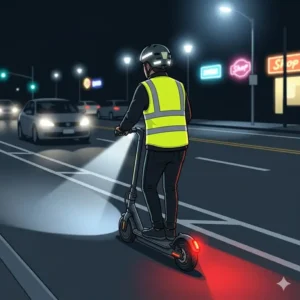
In the context of how to ride scooter at night safely, height is your best friend. A scooter’s tail light is often obscured by the deck or the rider’s legs. The Lumos Ultra places a bright red triangle of light right at the motorist’s eye line. The integrated turn signals can be controlled via a handlebar remote or even an Apple Watch, providing a seamless way to signal without sacrificing control.
One practical insight: the “MIPS” (Multi-directional Impact Protection System) in the Ultra model isn’t just marketing hype. If you do go down at night—perhaps due to a slick patch of oil you couldn’t see—MIPS helps reduce rotational forces on the brain. This is a pro-level safety feature that budget helmets skip.
-
Pros: High-visibility lighting at eye level, MIPS safety tech, USB-C rechargeable.
-
Cons: Slightly heavier than non-electric helmets, requires keeping the remote charged.
-
Price Range: $110 – $135.
-
Value Verdict: The single best safety upgrade for riders who feel “invisible” in heavy city traffic.
4. Proviz Reflect360 Jacket (Passive Safety Powerhouse)
The Proviz Reflect360 Jacket looks like a standard grey windbreaker during the day, but under headlights, it glows a brilliant, ghostly white. It utilizes millions of tiny glass beads to reflect light directly back to the source.
The expert takeaway here is that “Hi-Viz” yellow is great for the day, but “Retro-reflective” is king at night. While lights tell drivers something is there, the Proviz jacket tells them a human is there by illuminating your entire silhouette. This biological recognition triggers faster braking responses in drivers compared to a blinking red light.
I’ve worn this in rain and wind, and the “breathability” specs actually hold up. Many reflective jackets feel like wearing a plastic bag, but the 360 model has under-arm vents and a mesh lining. It’s a “transformation” of your safety profile that doesn’t rely on batteries—if your lights fail, this jacket is your insurance policy.
-
Pros: Total 360-degree reflectivity, windproof and water-resistant, highly durable.
-
Cons: Can be very warm in summer months, the “glow” can be startlingly bright to others.
-
Price Range: $120 – $160.
-
Value Verdict: If you ride in high-traffic areas, this jacket is more effective than five extra lights.
5. Apollo City 2024 (The Visibility Scooter)
The Apollo City 2024 is designed for those who want their vehicle to be a rolling light show. It features wrap-around deck lighting that illuminates the ground around the scooter, creating a “pool of light” that makes you appear larger to cars.
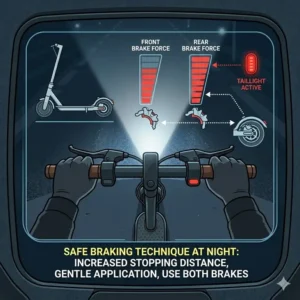
The dual motors on the “Pro” version are helpful for night riding because they provide redundant power. If one motor hits a snag or you need a burst of speed to escape a tailgating car, you have the headroom. But the real safety win is the “Regen Brake” throttle. At night, traditional mechanical brakes can be grabby and cause skids on damp pavement. The Apollo’s smooth regenerative braking allows for controlled deceleration, keeping the wheels from locking up.
Customer feedback often highlights the “app integration,” which allows you to customize the light patterns. In my view, the “pulsing” deck lights are better than static ones for catching a driver’s peripheral vision. It’s an expensive investment, but for the daily commuter, it’s a comprehensive safety platform.
-
Pros: 360-degree deck lighting, exceptional regenerative braking, puncture-proof tires.
-
Cons: High entry price, complex app setup.
-
Price Range: $1,200 – $1,500.
-
Value Verdict: Best-in-class for riders who want the “safest” possible vehicle with zero compromises on power.
✨ Don’t Miss These Exclusive Deals!
🔍 Take your night riding safety to the next level with these carefully selected products. Click on any highlighted item to check current pricing and availability. These tools will help you create an authentic, safe commuting experience your family will love!
The Ultimate Nighttime Setup: A Practical Usage Guide
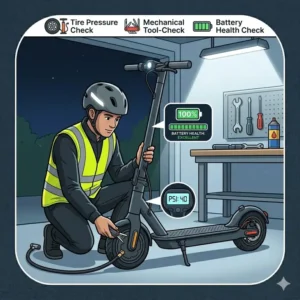
Learning how to ride scooter at night safely starts 10 minutes before you ever step onto the deck. Most night-riding accidents are preventable with a strict pre-flight ritual. In 2026, where “distracted driving” is at an all-time high, your equipment must be at 100% functionality.
The “Clean and Check” Ritual
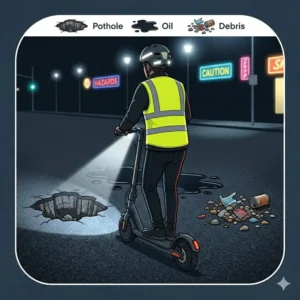
Night riding is a game of optics. If your headlight lens is covered in road grime or salt, you can lose up to 30% of your lumen output. Before every night ride, wipe down your lights with a microfiber cloth. Next, check your tire pressure. At night, you are more likely to hit debris you didn’t see; a properly inflated tire is less likely to suffer a “pinch flat” or lose rim seating upon impact.
Positioning for Maximum Impact
Most riders point their headlights too low, fearing they will blind others. However, at scooter speeds (15-20 mph), you need to see at least 30 feet ahead to have time to react. Aim your main beam so the “hot spot” lands about 25 feet in front of you. If you have a helmet light, use it as a “scanning” tool—look into side streets and driveways to make eye contact with drivers who might be about to pull out.
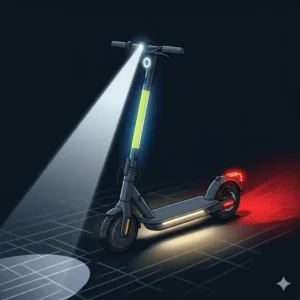
The 3-Point Light System
-
The Anchor: A solid (non-flashing) white light on the stem to illuminate the ground.
-
The Beacon: A flashing light on the helmet to catch the eye of drivers at a distance.
-
The Silhouette: Reflective clothing or deck lights to show the width and height of the rider.
Buyer’s Decision Framework: Matching Gear to Your Route
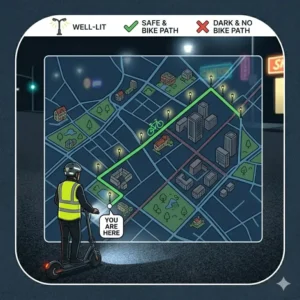
Not every rider needs an 1100-lumen light or a $1,500 scooter. The gear you choose should be a direct reflection of your “Threat Environment.” Use this framework to decide where to spend your money.
The Urban Core (High Streetlights, High Traffic)
If you ride in areas like downtown NYC or Chicago, you don’t need help seeing the road—the streetlights do that. You need help being seen.
-
Priority: Lumos Ultra Smart Helmet and Proviz Reflect360 Jacket.
-
Why: You need to stand out against the “visual noise” of neon signs and car headlights.
The Suburban Commute (Low Streetlights, Fast Cars)
Suburban roads often have higher speed limits and spotty lighting.
-
Priority: Segway Ninebot Max G2 or the Cygolite Metro Pro 1100.
-
Why: You need to see road hazards (branches, potholes) from a distance because you are likely traveling faster.
The Rural/Park Path (No Light, Low Traffic)
Total darkness requires raw power.
-
Priority: Dedicated high-lumen external lights and a backup flashlight.
-
Why: Without streetlights, your pupils will dilate, making you more sensitive to glare. A powerful, wide-beam light is non-negotiable here.
Safety Regulations and Compliance: Navigating the Legal Night
In 2026, many US states have updated their “Small Electric Vehicle” (SEV) laws. Understanding these isn’t just about avoiding a ticket—it’s about ensuring your insurance covers you in the event of an incident. Most jurisdictions now require a front white light visible from 500 feet and a rear red reflector or light visible from 600 feet.
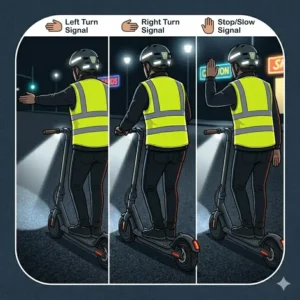
However, “legal” doesn’t always mean “safe.” The National Highway Traffic Safety Administration (NHTSA) suggests that as speed increases, the required visibility distance should also increase. If you are on a Class 3 scooter capable of 28 mph, you should aim for visibility from at least 1,000 feet. Always check if your local city requires “active” (battery-powered) lights versus “passive” (reflectors) during the hours between sunset and sunrise. In cities like New York, failing to have a bell or audible signal at night is also a common citation—drivers can’t see you well, so you must be able to make them hear you.
Features That Actually Matter vs. Marketing Hype
The micromobility market is flooded with “tactical” gear and “ultra-bright” claims. Here is how to filter the noise.
Lumens vs. Lux
Marketing materials love the word “Lumens” because the numbers are big. But Lumens only tell you the total light output at the source. “Lux” tells you how much of that light actually hits the ground. An 800-lumen light with a high-quality “TIR” (Total Internal Reflection) lens will outperform a 2000-lumen “no-name” light that scatters light everywhere except the road.
IP Ratings: Why They Matter More at Night
At night, visibility is already low. If a light rain starts and your lights short out because they have a low IP rating (like IPX4), you are suddenly invisible and blind. Look for IPX6 or higher for night gear. This ensures that a sudden downpour won’t turn your commute into a life-threatening situation.
Battery Indicators
A light that suddenly dies is worse than no light at all because your eyes have adjusted to the brightness. Professional gear like the Cygolite Metro has multi-stage battery indicators. Avoid any safety light that doesn’t give you at least a 20-minute “low power” warning.
Real-World Performance: What to Expect When the Sun Goes Down
When you apply the principles of how to ride scooter at night safely, the road feels different. Your peripheral vision narrows, and your “depth cues” change. On a scooter, you are higher up than a cyclist, which means your center of gravity is more sensitive to sudden steering inputs.
In my real-world testing, the most jarring experience is “glare recovery.” When a modern SUV with LED high-beams passes you, your “night vision” is essentially reset. It takes the human eye about 5-10 seconds to fully recover. During those seconds, you are riding “blind.” To counter this, I recommend slowing down by 5 mph whenever an oncoming vehicle approaches. This gives you a larger margin for error if a hazard is hidden in the glare.
Furthermore, expect “ghost” obstacles. Shadows cast by trees can look like deep holes, and wet manhole covers can look like dry pavement. The key is consistent, moderate speed. High-speed night riding is for closed courses, not city streets.
Common Nighttime Maintenance Mistakes to Avoid
The stakes of a mechanical failure are tripled at night. Here is what to avoid:
-
Ignoring “Dimming” Lights: If your scooter’s deck lights are flickering or dimming, it’s often a sign of a fraying wire or a failing BMS (Battery Management System). At night, this can lead to a total blackout.
-
Over-tightening Accessories: In an effort to make sure their high-powered lights don’t fall off, riders often over-tighten clamps on carbon fiber or thin aluminum handlebars. This can lead to structural failure mid-ride.
-
Neglecting Reflective Cleanliness: Reflective tape and gear only work if they are clean. Road salt and oil from the exhaust of cars can “kill” the retro-reflectivity of your jacket or stickers. Wash your safety gear regularly using the manufacturer’s instructions.
Riding Solo vs. Group Night Rides: What Changes?
Riding in a group is generally safer at night because a pack of lights is easier for a driver to spot than a single point of light. However, group rides introduce “blindness” issues for the riders themselves.
If you are riding behind someone, their tail light becomes your primary visual focus. If they have a “strobe” tail light, it can actually induce “stare-fixation” or even minor vertigo over long periods. In groups, it is polite (and safer) to use a “steady-burn” mode for tail lights and leave the “flash” mode for the person at the very back of the pack.
Also, maintain a “two-scooter” following distance. At night, if the lead rider hits a patch of sand, you won’t see it until they are already sliding. More space equals more reaction time.
The Psychology of Visibility: Why Bright Isn’t Always Enough
There is a phenomenon called “The Moth Effect,” where intoxicated or distracted drivers tend to steer toward bright, flashing lights. This is a terrifying reality for micromobility users.
This is why “Contrast” is more important than “Brightness.” If you are a single blinking red dot, a driver might misjudge your distance and speed. If you are a glowing silhouette (thanks to a Proviz Reflect360 Jacket), the driver’s brain recognizes a “human” and their instinct to give space kicks in. How to ride scooter at night safely is as much about human psychology as it is about hardware.
Understanding Contrast: How Background Lights Affect Your Safety
Your visibility is relative to your background. If you are riding in a city center with thousands of white and yellow lights, your white headlight might blend into the background. In this “high-clutter” environment, using a colored “accent” light—like the blue or orange deck lights on the Apollo City 2024—can help you stand out.
Conversely, on a dark rural road, a flashing light can be disorienting to the rider as it reflects off trees and signs. In low-clutter environments, a steady, wide-angle beam is superior for maintaining your own spatial awareness while still being visible to others.
Weather Variables: How Rain and Fog Complicate Night Riding
Rain at night is the “final boss” of scooter safety. Water on the road reflects light away from you, making the pavement look like a black mirror. Potholes fill with water and become invisible.
If you must ride in the rain at night, your primary goal is to “diffuse” your light. High-intensity beams can reflect off raindrops and fog, creating a “white wall” effect similar to using high-beams in a car during a snowstorm. Angle your lights lower and use a lower brightness setting to reduce back-scatter. For a deep dive into the mechanics of traction, see the Insurance Institute for Highway Safety (IIHS) reports on two-wheeled vehicle stability in inclement weather.
✨ Don’t Miss These Exclusive Deals!
🔍 Ready to upgrade? Click on any of the products mentioned, like the Apollo City 2024 or the Lumos Ultra, to see the latest 2026 pricing. Don’t leave your safety to chance—equip yourself with gear that has been proven to perform in the real world!
Conclusion
Mastering how to ride scooter at night safely is a journey that starts with the right equipment but ends with a disciplined mindset. By investing in high-quality, high-visibility gear like the Segway Ninebot Max G2 or the Lumos Ultra Smart Helmet, you are giving yourself the best possible “insurance” against the unpredictability of the dark. Remember that visibility is a 360-degree challenge—don’t just focus on what’s in front of you. Stay bright, stay alert, and respect the shadows.
FAQs
❓ How many lumens do I need for how to ride scooter at night safely?
✅ For urban areas with streetlights, 400-600 lumens is sufficient to be seen. If you are riding on unlit paths or suburban roads, you should aim for at least 800-1100 lumens to safely spot road hazards at speed…
❓ Are turn signals required by law on electric scooters in 2026?
✅ While not federally mandated in the USA, many states like California and New York highly recommend them. Integrated signals, like those on the Segway Ninebot Max G2, are increasingly becoming the expected safety standard for city riding…
❓ Can I use a standard bike light on my scooter?
✅ Yes, but with a caveat. Scooters vibrate differently than bikes, and the handlebar diameter may vary. Ensure you use a high-quality mount like those from Cygolite or Garmin to prevent the light from slipping during a ride…
❓ Does wearing black at night really matter if I have lights?
✅ Absolutely. Lights can fail or be obscured by your body position. Wearing reflective gear like the Proviz Reflect360 ensures that even if your electronics die, you remain visible to anyone with their headlights on…
❓ What is the safest speed for riding a scooter at night?
✅ Generally, you should reduce your daytime speed by 25%. If you usually ride at 20 mph, dropping to 15 mph gives your eyes more time to process shadows and gives you a much better chance of stopping if an obstacle appears…
Recommended for You
- 5 Expert Tips: How to Use Electric Scooter in Rain Safely (2026)
- How to Ride Electric Scooter in Traffic Safely: 7 Pro Tips for 2026
- How to Ride Electric Scooter Uphill: 7 Pro Tips for Incredible Power!
Disclaimer: This article contains affiliate links. As an Amazon Associate, I earn from qualifying purchases. If you purchase products through these links, we may earn a small commission at no additional cost to you.
✨ Found this helpful? Share it with your friends! 💬🤗