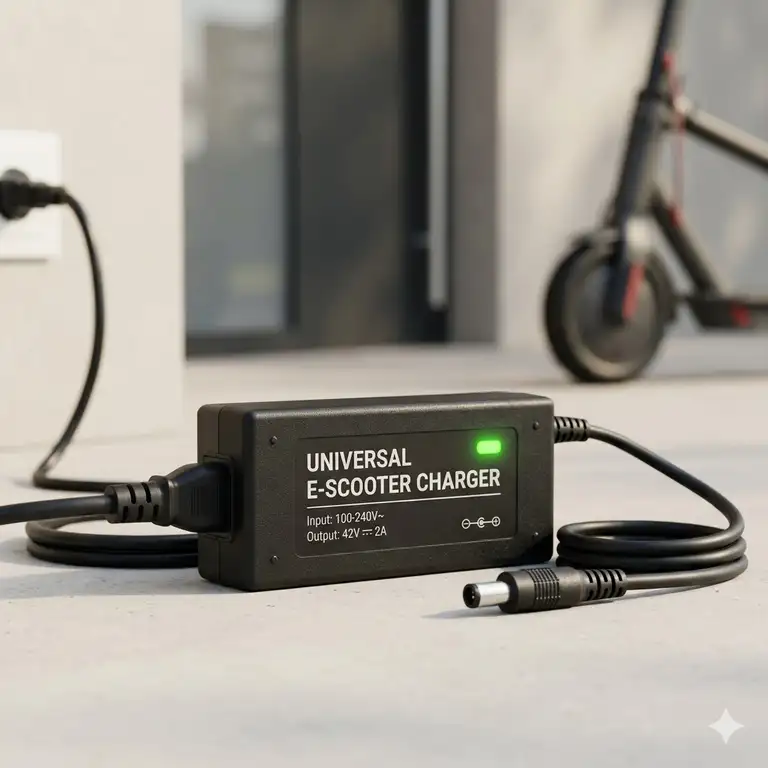
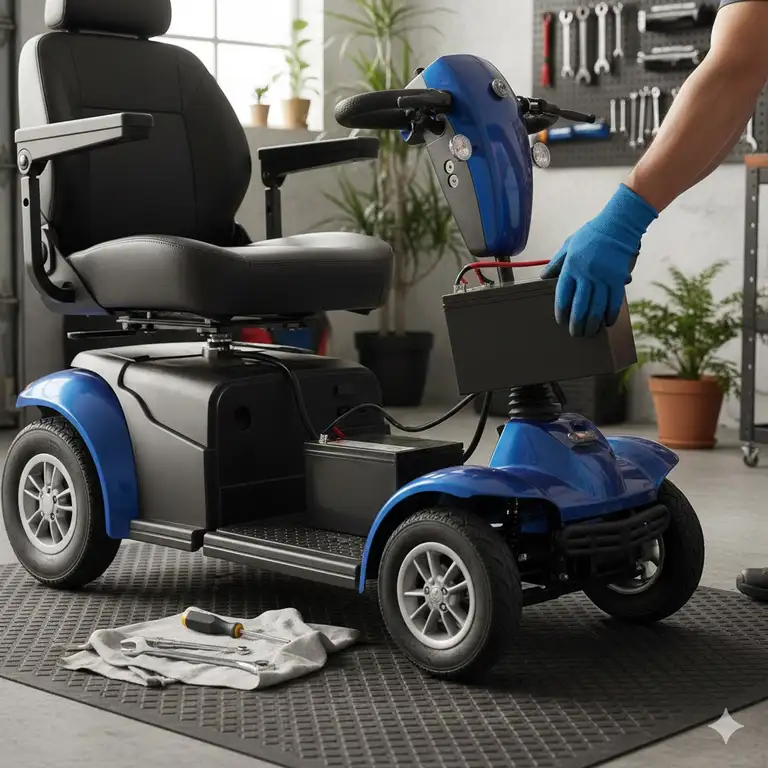
I know that sinking feeling all too well. You’re all set for a day out at the park or a trip to the local mall, you turn the key on your trusted ride, and… nothing. Or maybe it moves, but it has the enthusiasm of a sloth on a Monday morning. When your reliable companion starts losing its pep, it is almost certainly time to replace mobility scooter battery components to get back your independence.
✨Was this helpful? Spread the word! 🚀
I’ve spent years tinkering with electric mobility devices, and I can tell you that the battery is the heart of the machine. If the heart is weak, the whole body suffers. Choosing the right power source isn’t just about picking the first thing you see on a shelf; it’s about matching capacity, chemistry, and reliability to your specific lifestyle. Whether you are navigating the busy streets of New York or enjoying a quiet retirement community in Florida, having a dependable power source is non-negotiable. In this guide, I will walk you through the absolute best batteries for wheelchairs and scooters available in 2026, ensuring you never get stranded again.
Quick Comparison: Battery Replacement vs. Professional Servicing
Before we dive into the nitty-gritty of specific products, let’s look at how doing it yourself compares to taking your unit to a specialized shop.
| Feature | DIY Battery Replacement | Professional Service Center |
| Average Cost | $60 – $350 (Parts only) | $150 – $600 (Parts + Labor) |
| Time Investment | 20–45 Minutes | 2–5 Days (Drop-off/Pickup) |
| Technical Skill | Beginner to Intermediate | None Required |
| Warranty Support | Manufacturer only | Shop + Manufacturer |
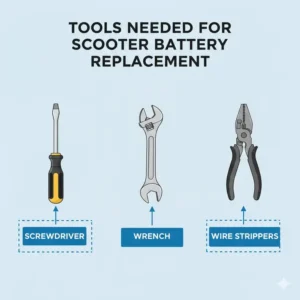
| Tools Needed | Screwdriver, Wrench | None |
| Customization | High (Choose your brand) | Low (Shop stock only) |
Top 7 Batteries for Mobility Scooters: 2026 Expert Analysis
When you need to replace mobility scooter battery sets, quality is your best friend. I have analyzed dozens of options currently dominating the market on Amazon to bring you the cream of the crop. These are real, high-performance units designed to handle the rigorous deep-cycle demands of daily mobility.
1. Mighty Max Battery 12V 35Ah SLA Battery (ML35-12)
The Mighty Max Battery 12V 35Ah SLA Battery is widely considered the gold standard for U1-sized battery compartments. If you own a mid-sized scooter from brands like Pride or Golden Technologies, this is likely your direct replacement. It uses Absorbent Glass Mat (AGM) technology, which means it is spill-proof and maintenance-free.
-
Technical Specifications:
-
Voltage: 12V
-
Capacity: 35Ah
-
Chemistry: SLA/AGM
-
Dimensions: 7.68 x 5.16 x 7.13 inches
-
Terminal: Internal Thread (Nut and Bolt)
-
Weight: 23.1 lbs
-
-
Customer Review Analysis: Users frequently praise its longevity, with many reporting 2+ years of heavy use. Some users noted that the weight is significant, but it reflects the lead density required for a true deep-cycle battery.
-
Professional Applications: Ideal for pavement-heavy use and indoor power wheelchairs.
-
Warranty: 1-year full replacement warranty.
-
Pros: High discharge rate, excellent vibration resistance, very affordable.
-
Cons: Heavy; requires two units for 24V systems.
2. ExpertPower 12V 20Ah Lithium LiFePO4 Battery
If you want to modernize your ride when you replace mobility scooter battery packs, the ExpertPower 12V 20Ah Lithium LiFePO4 Battery is a game-changer. Lithium Iron Phosphate (LiFePO4) is the future. It’s lighter, lasts longer, and provides consistent power until the very end of the charge.
-
Technical Specifications:
-
Voltage: 12.8V
-
Capacity: 20Ah
-
Cycles: 2,500 – 7,000 cycles
-
BMS: Built-in Battery Management System
-
Weight: 5.8 lbs
-
-
Customer Review Analysis: Customers are shocked by the weight reduction—it’s roughly 1/3 the weight of lead-acid. Reviewers mention it “feels like a new scooter” because the voltage doesn’t sag during hills.
-
Professional Applications: Perfect for travel scooters (Go-Go, Buzzaround) where weight matters for lifting into car trunks.
-
Warranty: 10-year lifetime estimate with a 3-year manufacturer warranty.
-
Pros: Incredible lifespan, extremely lightweight, fast charging.
-
Cons: Higher initial cost; may require a lithium-specific charger.
3. Weize 12V 55Ah Deep Cycle AGM Battery
For those with heavy-duty bariatric scooters or high-performance wheelchairs, the Weize 12V 55Ah Deep Cycle AGM Battery provides the massive energy reserves needed for all-day excursions. This is a “Group 22NF” or similar large-format battery.
-
Technical Specifications:
-
Voltage: 12V
-
Capacity: 55Ah
-
Chemistry: Deep Cycle AGM
-
Dimensions: 9.02 x 5.43 x 8.43 inches
-
Weight: 38.5 lbs
-
-
Customer Review Analysis: Users love the range boost. One reviewer mentioned traveling 15 miles on a single charge with these. Some warnings were issued regarding checking the dimensions of your battery tray first, as these are large.
-
Professional Applications: Outdoor rugged scooters, heavy power chairs, and medical equipment.
-
Warranty: 1-year warranty.
-
Pros: Massive capacity, great for long-distance travel, robust casing.
-
Cons: Very heavy; bulky.
4. Chrome Battery 12V 12Ah SLA Battery
Small, portable “boot scooters” often use the Chrome Battery 12V 12Ah SLA Battery. These usually come in a pair inside a plastic battery pack. When you replace mobility scooter battery units in these compact models, you need reliability in a small form factor.
-
Technical Specifications:
-
Voltage: 12V
-
Capacity: 12Ah
-
Dimensions: 5.94 x 3.86 x 3.98 inches
-
Terminal: F2 (Faston)
-
-
Customer Review Analysis: Rated highly for being an exact fit for the Pride Go-Go series. Users appreciate the “plug and play” aspect. A few mentioned they are great for “budget-conscious” owners.
-
Professional Applications: Lightweight travel scooters and kids’ electric wheelchairs.
-
Warranty: 18-month warranty (above average for this size).
-
Pros: Very inexpensive, easy to install, widely compatible.
-
Cons: Limited range (not for long trips).
5. Universal Power Group (UPG) 12V 18Ah AGM Battery (UB12180)
The Universal Power Group (UPG) 12V 18Ah AGM Battery (UB12180) is a mid-range powerhouse. It’s often used in larger travel scooters or as an upgrade for scooters that originally came with 12Ah or 15Ah batteries.
-
Technical Specifications:
-
Voltage: 12V
-
Capacity: 18Ah
-
Dimensions: 7.13 x 3.01 x 6.57 inches
-
Weight: 11.9 lbs
-
-
Customer Review Analysis: Consistently high marks for durability. Many reviews come from medical equipment technicians who trust UPG for patient reliability.
-
Professional Applications: Medical mobility, backup power, and mid-range scooters.
-
Warranty: 1-year warranty.
-
Pros: Trusted brand, excellent balance of size and power, spill-proof.
-
Cons: Slightly more expensive than generic brands.
6. Renogy 12V 100Ah Deep Cycle AGM Battery
If you have a high-end, off-road mobility vehicle or a complex power wheelchair with many electronic features (like power tilt or recline), you need the Renogy 12V 100Ah Deep Cycle AGM Battery. Renogy is a leader in solar and deep-cycle tech, and it shows.
-
Technical Specifications:
-
Voltage: 12V
-
Capacity: 100Ah
-
Design Life: 10 Years
-
Self-Discharge: Less than 3% per month
-
Weight: 63.9 lbs
-
-
Customer Review Analysis: “Unstoppable” is a word used often. Users who live in hilly areas say these batteries handle the inclines without heating up.
-
Professional Applications: Heavy-duty off-road mobility, long-term care facility equipment.
-
Warranty: 2-year warranty.
-
Pros: Incredible capacity, high-quality build, low self-discharge rate.
-
Cons: Extremely heavy; requires help to install.
7. Interstate Batteries 12V 35Ah AGM (DCM0035)
Interstate Batteries 12V 35Ah AGM (DCM0035) is the “safe bet.” You can find Interstate dealers almost anywhere in the USA, and their mobility line is specifically engineered for deep-cycle performance rather than just starting power.
-
Technical Specifications:
-
Voltage: 12V
-
Capacity: 35Ah
-
Chemistry: VRLA AGM
-
Dimensions: 7.72 x 5.16 x 6.42 inches
-
-
Customer Review Analysis: Praised for consistency. Reviewers note that even after 18 months, the range hasn’t noticeably dropped. The brand name provides peace of mind.
-
Professional Applications: Standard power chairs and mobility scooters for daily neighborhood use.
-
Warranty: 1-year industry-standard warranty.
-
Pros: Reliable brand, high-quality terminals, widely available.
-
Cons: Premium price tag compared to “white label” batteries.
✨ Don’t Miss These Exclusive Deals! 🔍
🔍 Take your mobility to the next level with these carefully selected products. Click on any highlighted item to check current pricing and availability. These batteries will help you regain the freedom and reliability you deserve! ✨
💬 Just one click – help others make better buying decisions too!😊
Technical Specifications Matrix: Comparing the Top 7
| Product Name | Voltage | Capacity | Type | Best For |
| Mighty Max 35Ah | 12V | 35Ah | AGM | Standard Mid-size |
| ExpertPower Lithium | 12.8V | 20Ah | LiFePO4 | Travel/Weight Loss |
| Weize 55Ah | 12V | 55Ah | AGM | Long Range/Large |
| Chrome Battery 12Ah | 12V | 12Ah | AGM | Small Portable |
| UPG 18Ah | 12V | 18Ah | AGM | Mid-range Travel |
| Renogy 100Ah | 12V | 100Ah | AGM | Extreme Duty |
| Interstate 35Ah | 12V | 35Ah | AGM | Reliable Daily |
Understanding Why You Must Replace Mobility Scooter Battery Sets in Pairs
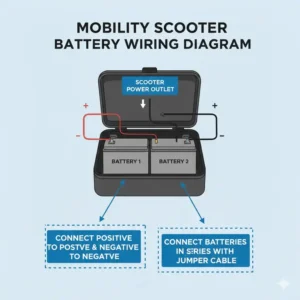
I cannot stress this enough: always replace both batteries at the same time. Most mobility scooters operate on a 24-volt system, which is created by connecting two 12-volt batteries in “series.”
When you connect two batteries in series, the voltage adds up:
If you mix an old battery with a new one, the new battery will work overtime to “pull” the old one along. This leads to the new battery wearing out prematurely—often in just a few months. It’s like wearing one new sneaker and one old, worn-out boot. You won’t walk straight, and you’ll eventually hurt your good leg! When looking for batteries for wheelchairs and scooters, always buy a matched pair or a “2-pack” listing.
Budget vs. Premium: Finding Your Value Sweet Spot
Choosing to replace mobility scooter battery units involves balancing your immediate budget with long-term savings.
| Feature | Budget (Generic AGM) | Mid-Range (Name Brand AGM) | Premium (Lithium/LiFePO4) |
| Initial Cost | $ | $$ |
|
| Cycle Life | 200 – 300 cycles | 300 – 500 cycles | 2,000+ cycles |
| Weight | Heavy | Heavy | Ultra-Light |
| Efficiency | 80% | 85% | 98% |
| Cost per Cycle | High (over time) | Moderate | Very Low |
While a premium Lithium battery like the ExpertPower 20Ah costs more upfront, it lasts about 10 times longer than a standard lead-acid battery. If you plan on keeping your scooter for more than 3 years, Lithium actually saves you hundreds of dollars in the long run.
The Step-by-Step Guide: How to Replace Mobility Scooter Battery
Replacing mobility scooter batteries is a task I believe almost anyone can do. You don’t need a degree in electrical engineering, just a bit of patience and a wrench.
Phase 1: Preparation
-
Turn off the power: Ensure the key is out of the ignition.
-
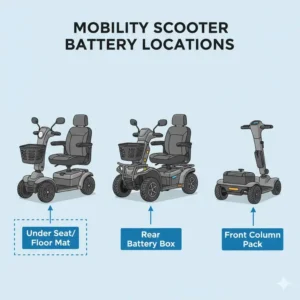
Access the batteries: On many travel scooters, the battery pack is a removable box. On larger scooters, you may need to lift the seat and remove a plastic shroud.
-
Take a Photo: Before you touch anything, take a picture of the wiring. You’ll thank me later when you’re trying to remember which wire goes to which terminal!
Phase 2: Removal
-
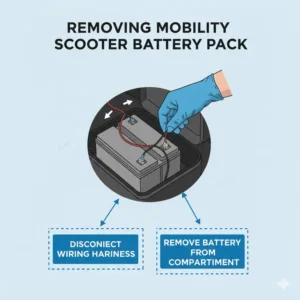
Disconnect the Negative (-): Always disconnect the black wire (negative) first. This prevents accidental sparks if your wrench touches the metal frame.
-
Disconnect the Positive (+): Now remove the red wire.
-
Remove the old batteries: They might be held down by a Velcro strap or a metal bracket.
Phase 3: Installation
-
Clean the terminals: If there is any white powder (corrosion), wipe it off with a cloth.
-
Place the new batteries: Ensure they are oriented the same way as the old ones.
-
Connect the Positive (+): Red wire first this time.
-
Connect the Negative (-): Black wire last.
-
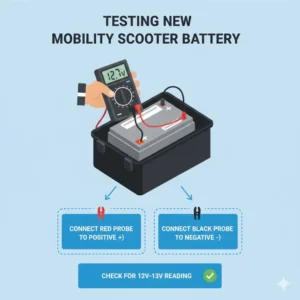
Secure and test: Tighten the bolts, put the cover back on, and turn on the key.
“I replaced my own batteries and saved $200 in labor. It took me 15 minutes, and I feel like a pro! Just make sure you get the right size for your tray.” — Typical DIY Review
Performance Metrics: AGM vs. Gel vs. Lithium
When researching batteries for wheelchairs and scooters, you’ll see these three terms. Here is how they stack up in the real world.
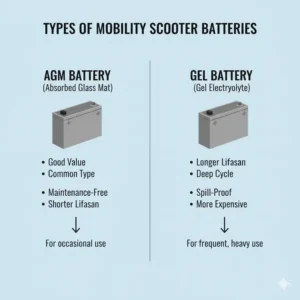
| Metric | AGM (Absorbent Glass Mat) | Gel Cell | Lithium (LiFePO4) |
| Vibration Resistance | Excellent | Good | Superior |
| Charging Speed | Moderate | Slow | Very Fast |
| Deep Discharge | Up to 50% | Up to 80% | Up to 100% |
| Maintenance | Zero | Zero | Zero |
| Temperature Tolerance | Good | Excellent | Good (but needs heat for charging in snow) |
AGM is the most common because it’s cheap and reliable. Gel is great for very hot climates or extremely deep discharges. Lithium is the modern choice for high performance and weight reduction.
Signs Your Battery is Failing (Don’t Ignore These!)
I’ve seen people get stuck in grocery stores because they ignored the warning signs. Keep an eye out for these red flags:
-
Decreased Range: You used to go to the park and back; now you barely make it to the driveway.
-
The “Hills” Struggle: Your scooter slows down significantly on even minor inclines.
-
Rapid Meter Drop: The battery gauge shows “Full” but drops to “Red” as soon as you pull the throttle.
-
Long Charging Times: If it takes 24 hours to charge and still doesn’t last, the internal resistance is too high.
-
Swelling: If the battery case looks “fat” or bloated, stop using it immediately! This is a sign of overcharging or internal failure.
Benefit Quantification: Why Upgrading Your Battery Matters
| Benefit | Impact of New Battery | Traditional “Old” Battery |
| Confidence | Go anywhere without fear of stalling. | Constant anxiety about range. |
| Speed | Maintains top speed throughout the trip. | Slows down as the day progresses. |
| Electronics | Lights and USB chargers work perfectly. | Dim lights and flickering displays. |
| Safety | No risk of getting stranded in traffic. | Potential for total power failure. |
According to the U.S. Department of Transportation, maintaining mobility devices is crucial for the safety of people with disabilities. A faulty battery isn’t just an inconvenience; it can be a safety hazard.
User Compatibility: Which Battery Fits Your Lifestyle?
| User Type | Recommended Battery | Why? |
| The World Traveler | ExpertPower 20Ah Lithium | Light enough for air travel and car lifting. |
| The Neighborhood Cruiser | Mighty Max 35Ah AGM | Reliable, cheap, and perfect for short trips. |
| The Heavy User | Renogy 100Ah AGM | Built for 24/7 use and long distances. |
| The Budget Buyer | Chrome Battery 12Ah | Best bang for your buck for small scooters. |
Advanced Maintenance: Making Your New Batteries Last
Once you replace mobility scooter battery units, you want them to last as long as possible. Here are my “pro tips” for battery longevity:
-
Charge Every Night: Unlike old cell phones, mobility batteries hate being empty. Even if you only used it for 10 minutes, plug it in at night.
-
Use the Right Charger: If you upgrade to Lithium, you must use a lithium-compatible charger. Using an old AGM charger on a lithium battery can damage the BMS.
-
Avoid Extreme Heat: Don’t leave your scooter in a baking-hot garage in 100-degree weather. Heat is the #1 killer of lead-acid batteries.
-
Room Temperature Charging: Batteries charge most efficiently at room temperature ($20^\circ C$ to $25^\circ C$).
-
Don’t Let Them Sit Empty: If you aren’t using the scooter for the winter, charge the batteries fully and disconnect them. A battery that sits empty for three months will likely be dead when you return.
Cost Comparison Over 5 Years
Let’s look at the math for a typical mid-sized scooter user.
-
Option A (Standard AGM): You spend $140 every 1.5 years. Over 5 years, that’s roughly 3 replacements. Total: $420.
-
Option B (Premium Lithium): You spend $350 once. It lasts the full 5 years (and likely 5 more). Total: $350.
Not only is Lithium cheaper over time, but you also save yourself the hassle of performing the replacement three times. This is why I often recommend the ExpertPower or similar lithium options to my friends.
✨ Don’t Miss These Exclusive Deals! 🔍
Take your mobility to the next level with these carefully selected products. Click on any highlighted item to check current pricing and availability on Amazon. These batteries will help you regain the freedom and reliability you deserve! ⚡
Conclusion: Take Back Your Freedom
Replacing your mobility scooter battery is one of the most empowering things you can do for your daily life. It is the difference between being “stuck at home” and “on the go.” Whether you choose the reliable Mighty Max 35Ah for its value or the high-tech ExpertPower Lithium for its performance, you are making an investment in your independence.
Remember to always replace in pairs, check your dimensions, and keep those new cells charged up. You’ve got a world to see—don’t let a tired battery hold you back!
Frequently Asked Questions
✅ No, you should never use car batteries. Car batteries are designed for 'starting' (high burst of power), while batteries for wheelchairs and scooters must be 'deep cycle' (slow, steady power over hours). Using a car battery will ruin the scooter's electronics...
✅ Most users need to replace mobility scooter battery sets every 12-18 months. However, if you use a high-quality AGM like Interstate or a Lithium battery, you may get 3-10 years of life depending on your charging habits...
✅ Yes, but there are rules. AGM and Gel batteries are generally 'spill-proof' and allowed. Lithium batteries must be under a certain Watt-hour (Wh) limit (usually 300Wh for mobility aids). Always check with your airline 48 hours before flying...
✅ This is called 'voltage sag.' It usually happens when you replace mobility scooter battery units with cheap, low-quality ones or when your current batteries are dying. The internal resistance is too high to maintain steady voltage under load...
✅ No. The batteries for wheelchairs and scooters recommended here are SLA (Sealed Lead Acid) or Lithium. They are maintenance-free and completely sealed. You should never attempt to open them or add water to them... ❓ Can I use car batteries in my mobility scooter?
❓ How often should I replace mobility scooter battery sets?
❓ Can I travel on an airplane with my mobility scooter batteries?
❓ Why is my scooter battery gauge jumping up and down?
❓ Do I need to water my mobility scooter batteries?
Recommended for You
- Best Fat Tire Scooter: Top 7 Power-Packed Rides for 2026
- Scooter Helmet Guide: 7 Best Rated Picks to Save Your Life!
- 7 Best electric scooter helmet for adults: 2026 Ultimate Safety Guide
Disclaimer: This article contains affiliate links. If you purchase products through these links, we may earn a small commission at no additional cost to you.
✨ Found this helpful? Share it with your friends! 💬🤗